
What to do when a client asks for carbon data
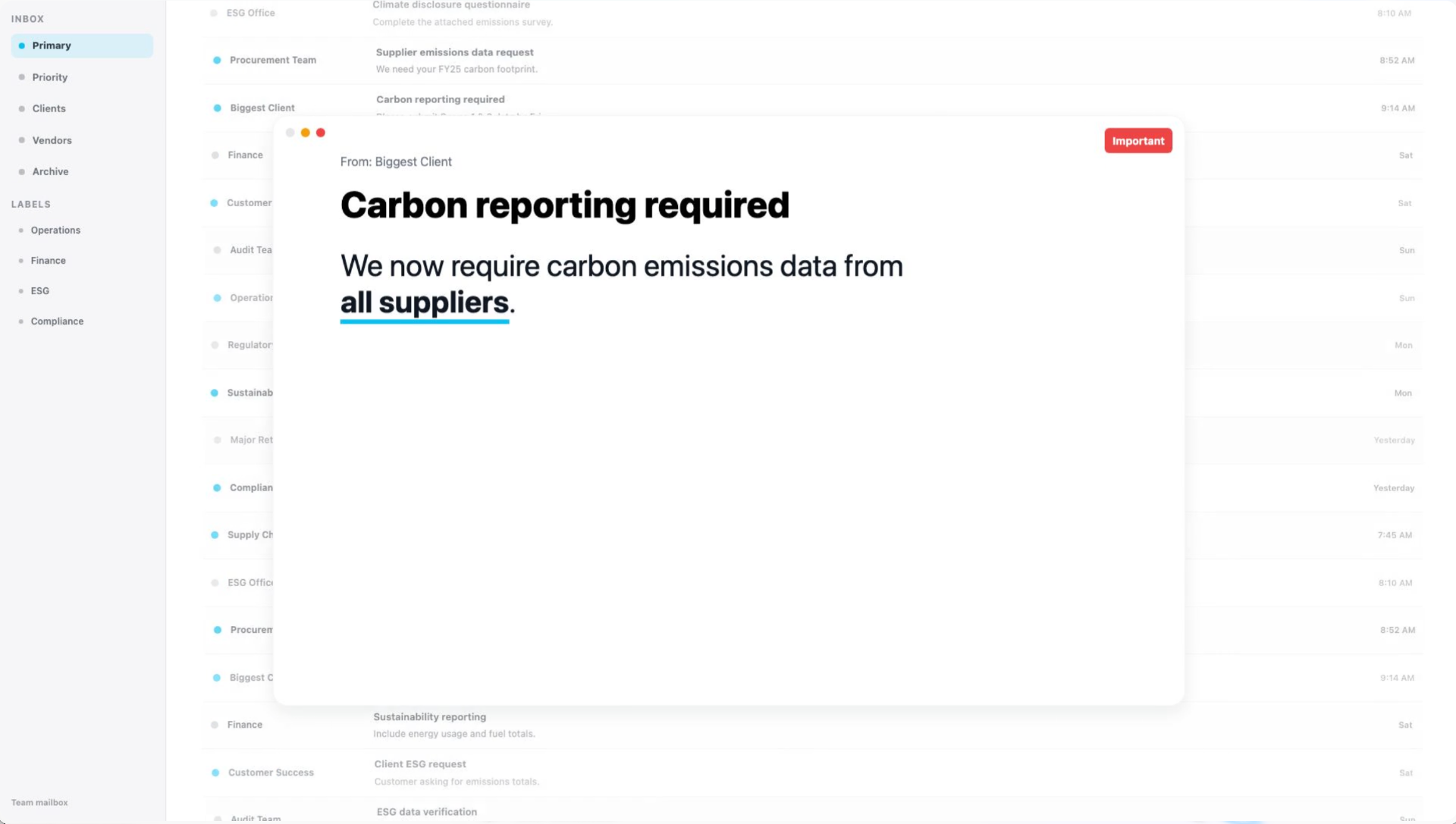
The email always arrives at the worst possible time. You're mid-project, juggling deadlines, and then it lands in your inbox: "As part of our supplier sustainability assessment, please provide your carbon emissions data by…"
If your first reaction is mild panic, you're not alone. After 5 years helping businesses navigate exactly this situation, we can tell you that most suppliers feel the same way when they receive their first carbon data request. The good news? It's far less complicated than it looks, and responding well can actually set you apart from your competitors.
What they're actually asking for
Before we dive into what to do, let's demystify what your client is really after. When procurement teams request "carbon data," they typically want to understand your business's greenhouse gas emissions. This usually breaks down into three categories:
- Scope 1 – Direct emissions from things you own or control, like company vehicles or gas boilers
- Scope 2 – Indirect emissions from the electricity and energy you purchase
- Scope 3 – Everything else in your value chain, from business travel to the products you buy and sell
Most initial requests focus on Scope 1 and 2 because they're easier to calculate. Some clients will ask for Scope 3 as well - if so, don't worry, we cover that in our Scope 3 guide for suppliers.
The 5-step response framework
Here's the approach I recommend to every supplier facing a carbon data request for the first time. It's straightforward, professional, and will make you look prepared even if you're starting from zero.
Step 1: Don't ignore it
This might sound obvious, but you'd be surprised how many suppliers let carbon requests sit in their inbox. Every week you delay, you're damaging the relationship. Procurement teams track response rates, and silence speaks volumes.
Even if you don't have the data ready, acknowledge receipt within 48 hours. A simple "Thank you for this request. We're gathering the information and will respond by [date]" goes a long way.
Step 2: Acknowledge receipt professionally
Your acknowledgement email should be brief but demonstrate competence. Confirm you've received the request, that you understand what's being asked, and provide a realistic timeline for your response.
Step 3: Understand the deadline and format required
Check the original request carefully. Is there a specific deadline? Do they want data in a particular format – perhaps a CDP questionnaire, a spreadsheet template, or a simple PDF report? If anything is unclear, ask. It's far better to clarify upfront than to submit the wrong thing.
Step 4: Gather your data
Here's where most suppliers overcomplicate things. You likely already have the data you need – it's just not labelled as "carbon data." Start with:
- Energy bills – Your electricity and gas invoices show kWh usage, which can be converted to emissions
- Fuel receipts – Vehicle fuel purchases, whether diesel, petrol, or electricity for EVs
- Travel records – Flight bookings, mileage claims, hotel stays
- Spend data – Your accounting system holds purchase data that can be used for Scope 3 calculations
For your first report, focus on getting the basics right. You don't need perfect data – you need credible data that you can improve over time.
Step 5: Calculate and submit
Once you have your data, you'll need to convert it into CO2 equivalent (CO2e) using emissions factors. This is where tools like EcoHedge Express can save you hours – it connects to your accounting software and handles the calculations automatically, giving you a report in minutes rather than days.
What "good enough" looks like for most requests
Perfectionism is the enemy of progress here. In my experience, most procurement teams aren't expecting supplier-level carbon data to be audited to the same standard as their own annual reports. What they want is:
- A clear figure they can use in their own Scope 3 calculations
- A methodology they can reference (GHG Protocol is the standard)
- Evidence that you're taking this seriously and improving over time
If your data is directionally correct and you can explain your methodology, you're ahead of most suppliers.
Common mistakes that make you look unprepared
Having reviewed thousands of supplier submissions over the years, these are the errors we see most often. For a deeper dive into each one, read our full guide on carbon reporting mistakes that lose tenders.
- Submitting nothing - The worst possible response. Even "we're working on this" is better than silence
- Vague commitments without numbers - "We're committed to sustainability" means nothing without data
- Using outdated data - Emissions from three years ago aren't relevant today
- Inconsistent units - Mixing kg and tonnes in the same report creates confusion
- No methodology reference - Always state that you're following GHG Protocol
How to turn this into a competitive advantage
Here's what we've learned after 5 years in this field: most of your competitors are making the mistakes listed above. By responding quickly, providing clear data, and demonstrating a credible methodology, you immediately stand out.
Procurement teams remember suppliers who make their jobs easier. When the next tender comes around, and sustainability increasingly features in scoring, you'll be in a stronger position. Some of the most successful supplier relationships we've seen started with a well-handled carbon data request.
The best approach is to get ahead of these requests entirely. If you've already calculated your carbon footprint, you can respond within hours rather than scrambling for weeks. Our SME guide to carbon accounting explains how to set up a sustainable reporting process that keeps you prepared year-round. And if you're wondering how long the whole process takes, our carbon reporting timeline guide breaks it down by company profile.
With the UK Sustainability Reporting Standards (UK SRS) now published, large companies will be required to disclose Scope 3 supply chain emissions - meaning carbon data requests from clients will only become more frequent and more detailed.
Get your carbon data ready in minutes
EcoHedge Express connects to your accounting software and generates a credible carbon report automatically – so you're ready for client requests before they even arrive.
Try EcoHedge ExpressRelated Articles
Scope 3 explained for suppliers (without the fluff)
The practical guide to Scope 3 emissions without the jargon overload.
Carbon reporting mistakes that lose tenders
The errors that consistently cost businesses contracts in competitive bids.
What procurement teams actually want (and what they don't)
What buyers really look for in supplier carbon data.
How long does carbon reporting actually take for a UK SME?
Realistic timelines by company size, accounting setup, and complexity.
UK Sustainability Reporting Standards: what businesses need to know in 2026
The regulatory landscape and what it means for your reporting obligations.