
Carbon reporting mistakes that lose tenders
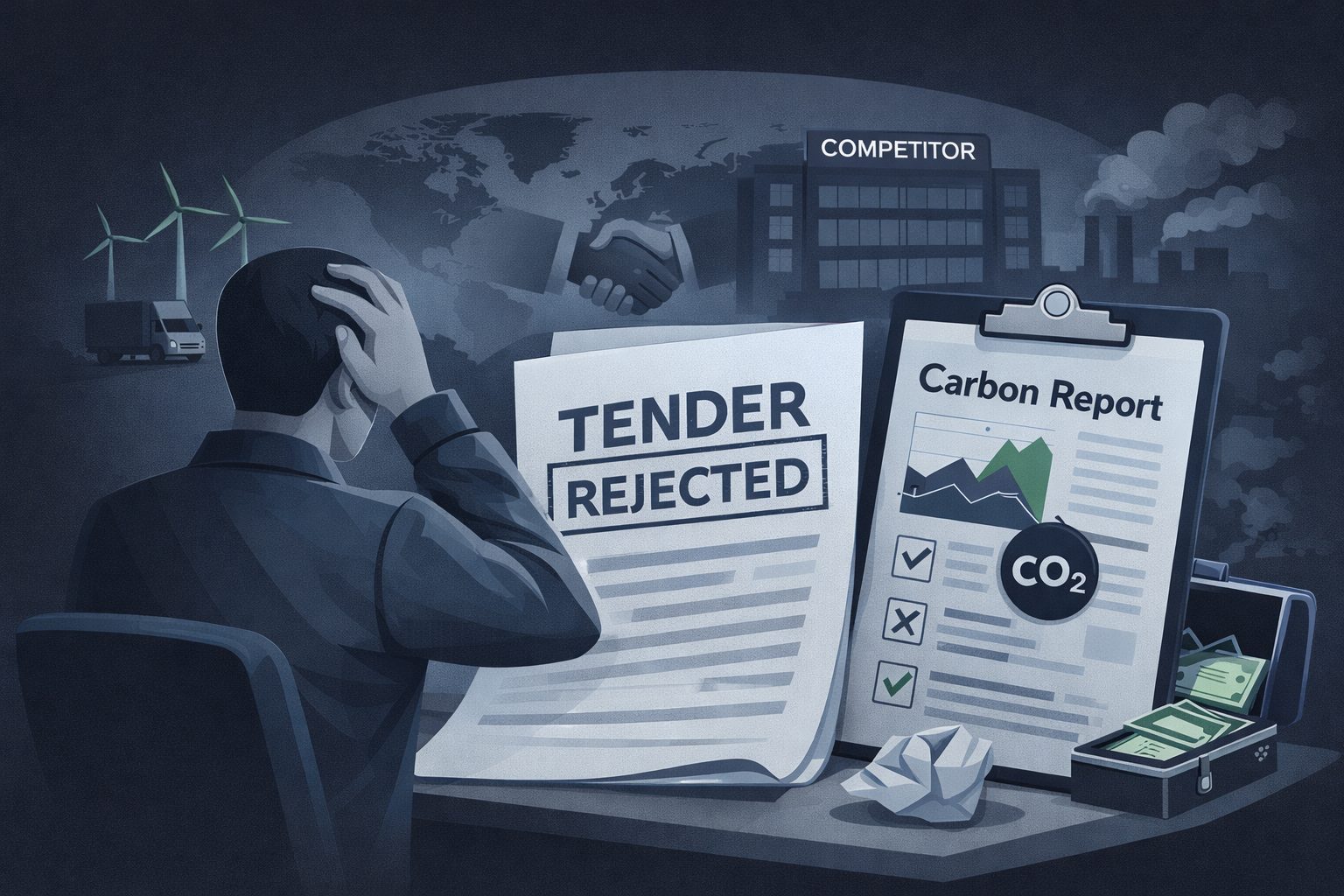
We've reviewed thousands of tender submissions over the past 5 years. The same carbon reporting mistakes keep appearing, and they keep costing suppliers contracts they should have won.
Here's the uncomfortable truth: sustainability now features in most public and large private sector tenders. If your carbon reporting isn't up to scratch, you're giving points away to competitors. And in a tight race, those points matter. With the UK SRS framework now published, large buyers will only increase scrutiny of supplier carbon data.
How procurement teams score carbon data
Before we get into the mistakes, it helps to understand what happens on the other side of the table. When a procurement team evaluates tender submissions, carbon and sustainability typically account for 10-20% of the total score. That might not sound like much, but in competitive bids where technical scores are similar, it's often the differentiator.
Evaluators are usually looking for:
- Evidence of current emissions measurement
- Clear methodology and data quality
- Reduction targets and progress
- Relevance to the contract scope
They're not expecting perfection. But they are expecting competence. And that's where most suppliers trip up.
The 7 contract-losing mistakes
Mistake 1: Submitting nothing
The silent disqualifier
Blank responses to carbon questions almost always result in zero points for that section. In some frameworks, it can trigger automatic disqualification.
This is the most common mistake, and the most damaging. When suppliers leave carbon sections blank – often because they don't have data ready – they're handing a scoring advantage to every competitor who submits anything at all.
Even a basic response with estimated figures and a clear commitment to improve is better than nothing. Silence signals that you haven't prioritised sustainability, and that's a red flag for procurement teams under pressure to decarbonise their supply chains.
Mistake 2: Vague commitments without numbers
"We are committed to sustainability" is not a carbon response. Neither is "We take environmental responsibility seriously" or "We're working towards net zero."
Evaluators need numbers. What are your current emissions? What's your target? By when? Statements without data score poorly because they can't be compared or verified. If you genuinely don't have emissions data yet, say so clearly and explain your plan to get it.
Mistake 3: Outdated data
Submitting emissions figures from 2021 in a 2025 tender suggests you haven't been measuring since then. Data more than two years old is essentially worthless for procurement evaluation – it doesn't reflect your current operations.
The expectation is annual reporting. If your last footprint was calculated three years ago, you need to update it before your next major bid. Tools like EcoHedge Express can generate an updated report in hours rather than weeks.
Mistake 4: Scope 1 & 2 only when Scope 3 was requested
Read the question carefully. Many tenders now specifically ask for Scope 3 emissions - your supply chain footprint. If you only submit Scope 1 and 2 (direct emissions and purchased electricity), you haven't answered the question.
Scope 3 is harder to calculate, which is precisely why procurement teams ask for it. It's a test of your sustainability maturity. If you can't provide it, explain why and outline your roadmap for adding it.
Mistake 5: Inconsistent units
We've seen tenders where emissions are reported in kg in one section, tonnes in another, and sometimes even pounds (weight, not currency). This makes your submission look sloppy and makes the evaluator's job harder.
Standard practice: Report in tonnes of CO2 equivalent (tCO2e) and use the same unit throughout. If the tender asks for a specific format, follow it exactly.
Mistake 6: No methodology reference
Where did your numbers come from? If you don't state your methodology, evaluators have no way to assess data quality. Always reference the standard you followed - for most businesses, this should be the GHG Protocol Corporate Standard or ISO 14064.
A simple statement works: "This footprint was calculated in accordance with the GHG Protocol Corporate Standard using location-based Scope 2 accounting." That single sentence adds credibility to your entire submission. You can verify the emission factors used through our public dataset.
Mistake 7: Carbon neutral claims without evidence
"We are carbon neutral" or "We are a net-zero company" are increasingly common claims – and increasingly scrutinised. If you make these statements, you need to back them up with:
- Your base year emissions
- Reductions achieved
- Offsetting details (if applicable) with certification references
- Scope coverage (many "carbon neutral" claims only cover Scope 1 and 2)
Unsubstantiated carbon neutral claims can actively harm your bid. Evaluators are trained to spot greenwashing, and vague claims raise suspicion about everything else in your submission.
What a winning submission looks like
The winning formula
- ✓ Current emissions data (within 12 months)
- ✓ Clear scope coverage (Scopes 1, 2, and 3 if requested)
- ✓ Methodology stated (GHG Protocol / ISO 14064)
- ✓ Reduction targets with timelines
- ✓ Progress to date with specific examples
- ✓ Contract-relevant commitments
Beyond the data itself, structure matters. Use clear headings, present figures in tables where appropriate, and make it easy for the evaluator to find what they need. Remember: they're reviewing dozens of submissions. Make theirs easy to score.
The weighting reality
Let's talk numbers. If a tender is worth £500,000 per year and sustainability accounts for 15% of the scoring, that's £75,000 of contract value influenced by your carbon response. Over a three-year framework, that's £225,000 riding on a section many suppliers rush through.
Even if you're confident in your technical solution, losing 10% of the available sustainability points can move you from first to third place. In competitive markets, that's the difference between winning and losing.
Quick wins before your next deadline
Got a tender deadline approaching? Here's what you can do in the next week to improve your carbon response:
- Get current data. Use EcoHedge Express to generate an up-to-date footprint from your accounting data
- Review the question. What exactly are they asking for? Match your response to their requirements
- Add methodology. State that you follow GHG Protocol – it takes one sentence
- Include a target. Even a modest reduction target shows intent
- Proofread for consistency. Check units, dates, and figures throughout
For more on what procurement teams are actually looking for, see our companion piece: What procurement teams actually want (and what they don't). And if you're wondering how long the whole process takes, our carbon reporting timeline guide breaks it down by company profile.
If a client has just asked for your carbon data and you're not sure where to start, read what to do when a client asks for your carbon data first.
Generate tender-ready carbon reports in minutes
EcoHedge Express connects to your accounting software and produces a GHG Protocol-compliant carbon report – ready for your next bid.
Try EcoHedge ExpressRelated Articles
What procurement teams actually want (and what they don't)
What buyers really look for in supplier carbon data.
Scope 3 explained for suppliers (without the fluff)
The practical guide to Scope 3 emissions without the jargon overload.
How long does carbon reporting actually take for a UK SME?
Realistic timelines by company size, accounting setup, and complexity.
What to do when a client asks for your carbon data
The step-by-step response guide for carbon data requests.
UK Sustainability Reporting Standards: what businesses need to know in 2026
The regulatory landscape and what it means for your reporting obligations.