
Scope 3 explained for suppliers (without the fluff)
After 5 years helping SMEs with carbon reporting, we still think "Scope 3" is a terrible name. It sounds like something from a spy film, not a business term. But it's the language the industry has settled on, and increasingly, it's the language your customers are using when they ask for your emissions data.
If you've received a request that mentions Scope 3 and felt your eyes glaze over, this guide is for you. No jargon, no fluff – just a practical explanation of what it means and what you actually need to do about it.
The 30-second explanation
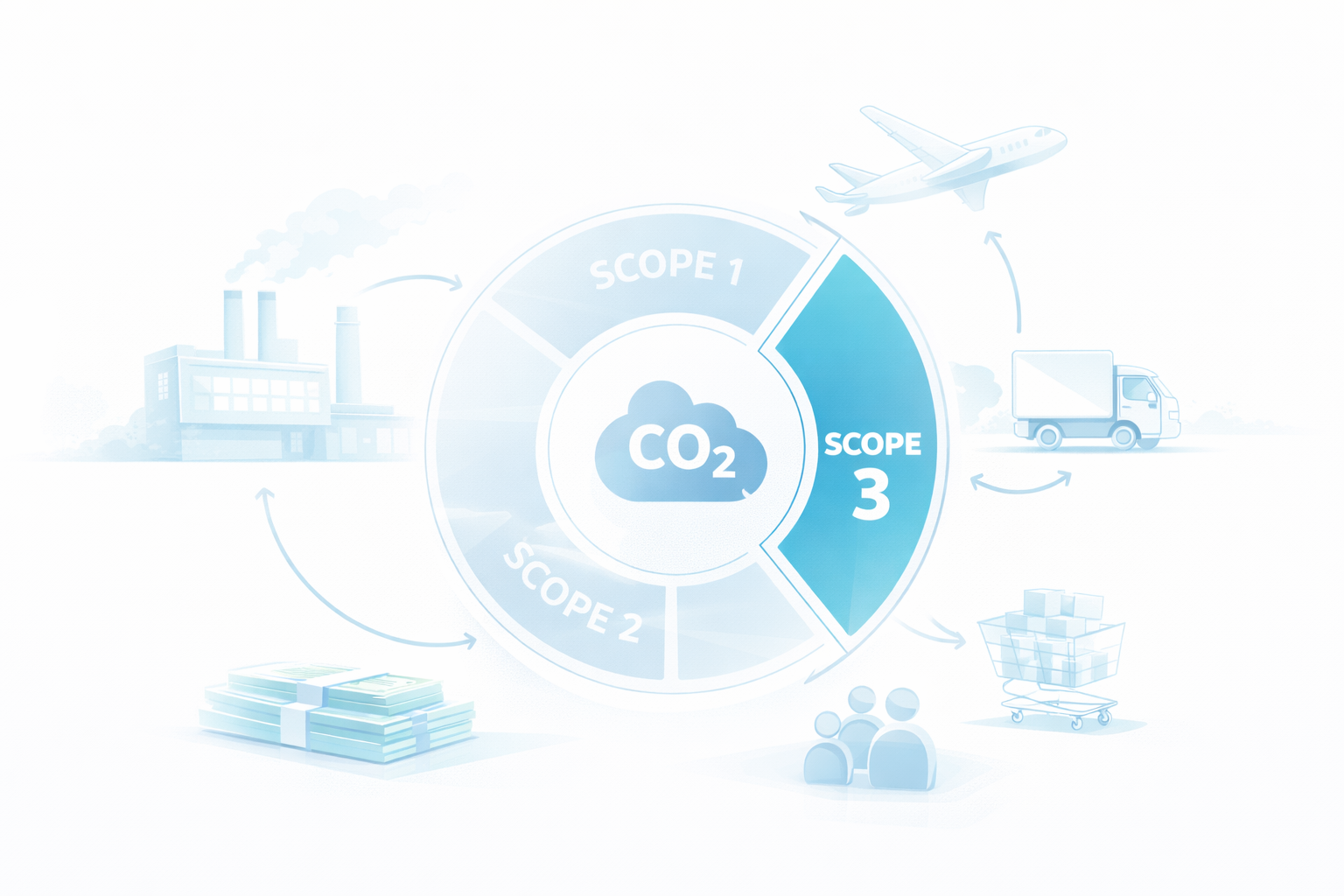
All carbon emissions are divided into three "scopes." Here's what each one means in plain English:
Scope 1 – What you burn directly. This includes any fuel combusted by your organisation: natural gas for heating, diesel in company vehicles, and so on. If you light it on fire and it's yours, it's Scope 1.
Scope 2 – The energy you buy. Electricity, primarily. The power station burns fuel to generate electricity; you buy that electricity. The emissions happen elsewhere, but they're a direct consequence of your consumption.
Scope 3 – Everything else. This is where it gets interesting. Scope 3 covers all the emissions in your value chain that aren't Scope 1 or 2. The products you buy. The way your goods get shipped. Business travel. Even how your employees commute. It's by far the largest category for most organisations.
Why your customers care about YOUR emissions
Here's the key insight: when a large company calculates their Scope 3 emissions, your emissions become their emissions.
Let's say you supply components to a manufacturer. When they calculate their "purchased goods and services" emissions (Category 1 of Scope 3), they need to include the carbon footprint of everything they bought from you. That's why they're asking you for data.
This ripple effect explains why you're suddenly receiving these requests. Major corporations are under pressure from investors, regulators, and consumers to report their full carbon footprint. Since Scope 3 often represents 70-90% of a large company's total emissions, they can't ignore their supply chain. And that means they need data from you.
The Scope 3 categories that matter to suppliers
Scope 3 has 15 categories in total. Most of them won't be relevant to your business. Here are the three that typically matter most for suppliers:
Category 1: Purchased goods and services
This is usually the big one. It covers everything you buy to run your business and make your products. Raw materials like steel, aluminium, and plastics, packaging, office supplies, professional services – all of it carries embedded carbon from how those items were produced and transported to you.
What this means for you: If a customer asks for your "product carbon footprint," this is what they're getting at. They want to know the emissions associated with what you sold them.
Category 4: Upstream transportation
How do materials get to your facility? Whether it's a container ship (check out these affordable shipping container options) from Asia or a van from a local warehouse, that transport has a carbon cost. This category captures emissions from getting supplies to you before you do anything with them.
What this means for you: If you can show you're sourcing more locally or using lower-carbon shipping methods, that's a genuine emissions reduction you can demonstrate.
Category 11: Use of sold products
This one's only relevant if your products use energy when your customers use them – think electronics, appliances, or anything with a plug. The emissions generated during the product's lifetime belong in this category.
What this means for you: If you make energy-consuming products, designing for efficiency directly reduces your Scope 3 footprint.
What your customers are actually calculating
Understanding this from their perspective helps. When your customer reports their emissions, they need a number for every supplier. Ideally, they'd use supplier-specific data – the actual emissions from your operations. That's what they're asking you for.
If you don't provide it, they'll use industry averages instead. These are usually higher than reality for well-run businesses, which makes you look worse on their reports than you actually are. More importantly, if you can provide real data and your competitor can't, you become the easier supplier to work with.
The emissions factor explained
You'll encounter this term a lot, so let's demystify it. An emissions factor is simply a number that converts activity data (like kWh of electricity or litres of fuel) into CO2e (carbon dioxide equivalent).
For example, if the emissions factor for UK grid electricity is 0.21 kg CO2e per kWh, and you used 10,000 kWh, your Scope 2 emissions are 2,100 kg CO2e. The factor does the conversion for you.
Different countries, fuels, and activities have different factors. The good news is you don't need to look these up yourself – any decent carbon accounting tool (including EcoHedge) handles this automatically using official government or industry databases. You can browse the full dataset in our Emission Factor Explorer.
"I don't have exact data" – what to do
Here's a reality check from someone who's been doing this for over two decades: nobody has perfect data. The companies with the most sophisticated sustainability teams still rely on estimates and averages for significant portions of their footprint.
The approach that works is pragmatic:
- Use spend-based estimates where you don't have activity data. If you know you spent £10,000 on a category of goods, emissions factors exist that convert that spend into an emissions estimate.
- Improve over time. Start with what you have. Next year, try to get better data for your biggest spending categories.
- Be transparent about your methodology. State clearly where you've used estimates versus actual data. Customers respect honesty.
Our comprehensive Scope 3 tracking guide walks through the spend-based approach in detail, including how to improve accuracy over time.
Why this won't go away
If you're hoping this is a passing fad, the trajectory is firmly in the other direction. Several regulatory developments are making Scope 3 reporting mandatory for larger companies:
- CSRD (Corporate Sustainability Reporting Directive) – EU regulation requiring detailed sustainability reporting from large companies, including supply chain emissions
- CBAM (Carbon Border Adjustment Mechanism) – The EU's carbon tariff system, which puts a price on embedded carbon in imports
- SEC Climate Disclosure rules – US requirements for public companies to disclose climate risks and emissions
As more of your customers face these requirements, they'll need data from you. The suppliers who can provide it easily will have an advantage. Check our glossary for more detail on these regulatory terms.
The bottom line: understanding Scope 3 isn't optional anymore. But it's also not as complicated as the jargon makes it sound. Focus on the categories that matter to your business, get your data in order, and you'll be well ahead of most of your peers.
Calculate your Scope 3 emissions automatically
EcoHedge connects to your accounting software to calculate Scope 1, 2, and 3 emissions in minutes – no spreadsheets required.
Get started free