
Fleet Electrification: CO2 Reporting Tools
Fleet Electrification: CO2 Reporting Tools
Switching to electric vehicles (EVs) can cut emissions and lower costs for UK businesses, but tracking CO₂ is key to making the most of these benefits. Many fleet managers still rely on outdated methods, like spreadsheets, or fail to calculate emissions altogether. This is where CO₂ reporting tools come in - they help businesses measure, report, and comply with regulations like SECR (Streamlined Energy and Carbon Reporting).
Key takeaways:
- EVs shift emissions from fuel (Scope 1) to electricity (Scope 2), requiring accurate tracking.
- Tools like EcoHedge and Geotab simplify reporting for UK fleets, automating data collection and ensuring compliance.
- Reporting not only meets legal requirements but also identifies cost savings and demonstrates accountability to clients.
Businesses need to act now, as regulations tighten and clients increasingly demand emissions data. Choosing the right CO₂ tracking tool ensures compliance, cuts inefficiencies, and supports decarbonisation goals.
Why CO2 Reporting Matters for Fleet Electrification
CO2 reporting isn't just a box-ticking exercise - it’s now a legal requirement. Since April 2019, the Streamlined Energy and Carbon Reporting (SECR) regulations have made it mandatory for UK quoted companies, large unquoted companies, and large Limited Liability Partnerships (LLPs) to include annual energy use and greenhouse gas emissions in their Directors' Reports.
But the importance of CO2 reporting goes far beyond compliance. It provides a clear starting point for reducing emissions, helping businesses pinpoint where the most meaningful reductions can be made. For example, in 2021, transport was responsible for nearly 26% of the UK's total emissions, with road transport making up a staggering 91% of that figure. Switching just one diesel refuse collection vehicle for an electric alternative could slash annual CO2e emissions from 330 kilotonnes to 40 kilotonnes. Without accurate tracking, these opportunities often go unnoticed. Using the right carbon reporting software can help identify these gaps. These regulations not only ensure compliance but also pave the way for better understanding and action on decarbonisation.
UK Regulatory Requirements
The UK's regulatory framework is more detailed than many fleet operators might think. SECR applies to UK quoted companies as well as "large" unquoted companies and LLPs. These are defined by specific financial thresholds and employee numbers under the Companies Act 2006. Fleet operators must use the annually updated government conversion factors to translate data like distance travelled or energy consumed into CO2 equivalents. These conversion factors are updated every year to reflect changes in the energy grid, ensuring that reporting stays precise.
Interestingly, even smaller businesses (SMEs) not directly covered by SECR are increasingly required to report emissions. Larger corporate clients often demand this data as part of procurement processes. The Department for Environment, Food & Rural Affairs highlights the benefits of this approach:
"There are direct benefits to organisations from measuring and reporting as they will benefit from lower energy and resource costs, a better understanding of their exposure to the risks of climate change and a demonstration of leadership".
Business Advantages of CO2 Reporting
Beyond legal compliance, CO2 reporting can lead to tangible savings. Battery electric vehicles (BEVs) emit three times less CO2 than their petrol or diesel counterparts. Fleets that transition to electric can reduce energy use by up to 75% and benefit from maintenance costs that are 40% lower due to simpler mechanical systems.
Take Manchester City Council, for example. In April 2021, they invested £10 million to replace nearly half of their fleet with 27 fully electric refuse vehicles. This move cut their annual CO2 emissions by around 900 tonnes - about 3% of the council's total direct emissions. Nottingham City Council also made strides, transitioning 45% of its fleet (215 vehicles) to ultra-low emission models by 2021. Their electric street sweepers alone saved approximately £20,000 in fuel costs per vehicle each year. These examples show how tracking emissions can turn ambitious sustainability goals into measurable environmental and financial wins.
CO2 Reporting Tools for Electric Vehicle Fleets
Choosing the right CO2 reporting tool can save time and ensure compliance, especially for fleets transitioning to electric vehicles. Modern platforms offer tailored, automated solutions to simplify the process.
EcoHedge

EcoHedge helps UK SMEs streamline carbon accounting by automating data structuring, reducing up to 48% of the labour time typically spent on manual reporting tasks. It integrates seamlessly with accounting platforms like Xero and uses AI-driven categorisation to automatically sort transactions and calculate Scope 1, 2, and 3 emissions. Since Scope 3 emissions often make up the largest portion of a company's carbon footprint, this feature is particularly valuable.
The platform also provides audit-ready evidence trails that meet SECR requirements, making it easier to satisfy corporate procurement demands. Pricing starts at £24 per month (or £240 annually) for the Starter plan, which includes pay-as-you-go reporting, CSV uploads, and email support. For £99 per month (or £990 annually), the Growth plan adds unlimited reporting, Xero integration, custom branding, and advanced analytics. Users appreciate how EcoHedge simplifies the path to net zero.
While EcoHedge focuses on automated accounting, other platforms use telematics for real-time fleet data.
Geotab Fleet Electrification Planning Tool
Geotab's Sustainability Centre adopts a telematics-based approach, collecting real-time data from vehicles equipped with Geotab GO devices. This enables tracking of fuel economy, idling, and emissions intensity, helping businesses meet CSRD compliance requirements. The platform supports over 200 EV models, making it a versatile tool for fleets transitioning to electric.
One standout feature is the Electric Vehicle Suitability Assessment (EVSA), which analyses real-world driving data to recommend EV replacements that align with a fleet's specific range and duty cycle needs. For instance, Madrid City Council fitted its electric vehicles with Geotab GO devices to monitor energy use and range, helping identify under-utilised vehicles and improve operational efficiency. For Scope 2 reporting, Geotab tracks "well-to-wheel" emissions by monitoring energy consumption and incorporating UK Grid carbon intensity data, which was 0.21302 CO2e per kWh in 2022. Enrique García, a Technician from the Department of Climate Change, highlighted the importance of telematics:
"You cannot manage an electric fleet without telematics technology. Geotab's real-time and remote data is key to analyse the state of each vehicle and improve efficiency and sustainability."
Geotab's charge assurance dashboard enhances charging efficiency by over 160%. Real-world results include Milk & More saving 1.8 million litres of diesel and 4,920 tonnes of CO2 annually, while United Utilities achieved a 35% improvement in fleet fuel economy.
Feature Comparison Across Tools
CO2 Reporting Tools Comparison for UK Fleet Electrification
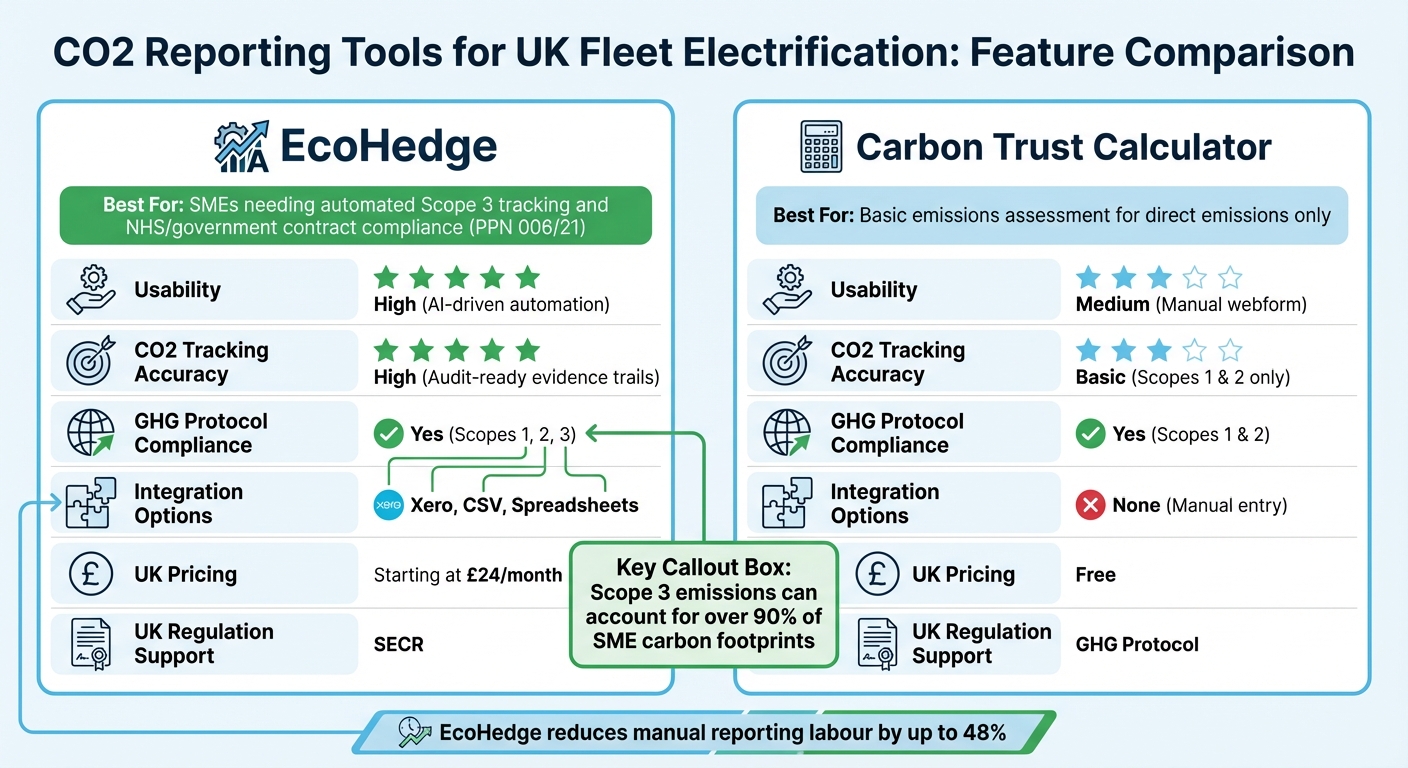
When it comes to accurate CO2 tracking, choosing the right tool is critical for UK fleet electrification. Comparing features like automation, compliance, and cost can help businesses make informed decisions. For UK SMEs, the stakes are particularly high, with challenges such as tight budgets, short tender deadlines, and the often overwhelming task of tracking Scope 3 emissions - which can account for over 90% of their total carbon footprint.
EcoHedge leverages AI-driven categorisation for streamlined automation and integrates smoothly with Xero, while the Carbon Trust Calculator provides a free but basic assessment tool. Below is a quick comparison of key features and pricing tailored to UK fleet operators.
Comparison Table
| Tool | Usability | CO2 Tracking Accuracy | GHG Protocol Compliance | Integration Options | UK Pricing (Starting) | UK Regulation Support |
|---|---|---|---|---|---|---|
| EcoHedge | High (AI-driven automation) | High (Audit-ready evidence trails) | Yes (Scopes 1, 2, 3) | Xero, CSV, Spreadsheets | £24/month | SECR |
| Carbon Trust Calculator | Medium (Manual webform) | Basic (Scopes 1 & 2 only) | Yes (Scopes 1 & 2) | None (Manual entry) | Free | GHG Protocol |
For SMEs aiming to secure NHS or government contracts, meeting Public Procurement Notice (PPN) 006/21 compliance is a must. EcoHedge provides detailed, audit-ready reports that align with SECR requirements, making it a strong choice for businesses looking to meet stringent standards. On the other hand, the Carbon Trust Calculator primarily focuses on direct emissions (Scopes 1 and 2), leaving out the broader Scope 3 categories that are increasingly demanded by corporate buyers.
Integration is another deciding factor. EcoHedge’s seamless connection with Xero eliminates the need for manual data entry, significantly reducing errors and saving time - two things every SME could use more of.
sbb-itb-919600f
CO2 Reporting Best Practices for Fleet Electrification
Collecting Accurate Data
The foundation of reliable CO₂ reporting lies in establishing a clear baseline to identify areas for potential carbon reduction. When it comes to road transport, reporting should cover three key greenhouse gases: carbon dioxide (CO₂), methane (CH₄), and nitrous oxide (N₂O). These are expressed as carbon dioxide equivalent (CO₂e) to comply with international standards.
To gather activity data - such as distance travelled (in kilometres), fuel usage (litres), or energy consumption (kilowatt-hours) - you can rely on telematics systems, fuel cards, expense claims, or odometer readings [7,15]. After collecting this data, convert it using the UK Government Greenhouse Gas Conversion Factors, which are updated annually (with the 2025 version released on 10th June 2025). For small and medium-sized enterprises (SMEs) just beginning their reporting journey, the government’s "condensed set" of conversion factors can simplify the process.
It’s also essential to classify emissions data by scope:
- Scope 1: Direct emissions from vehicles using petrol or diesel.
- Scope 2: Emissions from electricity purchased to charge electric vehicles.
- Scope 3: Indirect emissions, such as those from employee-owned vehicles used for business travel.
In fact, 92% of Fortune 500 companies responding to the CDP in 2016 adhered to the GHG Protocol for this framework. By following these precise measurements, you’ll be well-equipped to meet strict reporting requirements.
Meeting Regulatory Requirements
In the UK, compliance hinges on using official conversion factors and reporting CO₂e rather than just CO₂ [3,7]. The UK Government Conversion Factors are specifically tailored to align with Streamlined Energy and Carbon Reporting (SECR) regulations, making them a critical resource for SMEs.
For those using automated reporting tools, the government offers a "flat file" version of the conversion factors to enable smoother integration. Additionally, it’s worth reviewing the "what's new" sheet included in each annual update to ensure consistent reporting practices year after year.
Sharing Sustainability Results
Once you’ve gathered accurate data and ensured regulatory compliance, the next step is sustainability and carbon reporting. Clear and open reporting not only meets regulatory expectations but also enhances your reputation in a market that increasingly values environmental responsibility. As GOV.UK highlights, organisations that measure and report emissions "will benefit from lower energy and resource costs, a better understanding of their exposure to the risks of climate change and a demonstration of leadership which will help strengthen their green credentials".
Many larger companies now request emissions data from their SME suppliers as part of procurement processes. This makes voluntary Scope 3 reporting a smart move, even if it isn’t mandatory [4,12]. Use your baseline data to showcase measurable carbon savings over time, and consider adopting a "well to wheel" approach. This combines "tank to wheel" factors with upstream emissions from fuel extraction and distribution, giving stakeholders a complete picture.
Conclusion
Fleet electrification holds immense promise for reducing carbon emissions, but its success hinges on precise measurement and transparent reporting. Establishing a baseline and understanding the differences between Scope 1, 2, and 3 emissions are crucial steps. Using official UK Government Conversion Factors ensures accuracy and consistency in any decarbonisation strategy. As the Energy Saving Trust advises, "The first step is to start calculating your current fleet emissions. This will give you a baseline to work from and help you to identify where you can make carbon savings". Robust data is the cornerstone of the practical approaches discussed earlier.
Among these, EcoHedge offers a standout solution for small and medium-sized enterprises (SMEs) in the UK. Its automated carbon accounting system simplifies data collection, categorisation, and reporting, ensuring businesses can produce audit-ready reports that comply with SECR requirements. Elle, a business owner, shared her experience: "EcoHedge has been an invaluable asset to my business as we tackle the demands of selling our products to larger corporations. The need for sustainability reports had become a significant roadblock to securing deals".
With UK regulations tightening, such as the Corporate Sustainability Reporting Directive (CSRD) mandating SMEs to submit sustainability reports for the 2026 financial year by 2029, compliance is becoming more critical. Beyond regulatory demands, accurate CO₂ reporting highlights inefficiencies and can unlock new business opportunities.
Whether you're managing a fleet, running a small business, or overseeing sustainability initiatives, adopting automated CO₂ reporting tools now ensures compliance with evolving regulations while showcasing environmental responsibility. These tools not only help meet legal requirements but also position businesses to gain operational advantages and strengthen relationships with stakeholders and customers. Embracing automated CO₂ reporting today sets the stage for a smoother and more efficient transition to a sustainable fleet.
FAQs
What are the benefits of using CO2 reporting tools for businesses?
CO2 reporting tools give businesses a clear picture of their carbon footprint, making it easier to measure and monitor greenhouse gas emissions. With accurate data, companies can pinpoint the main sources of emissions and develop targeted strategies to reduce them. This approach not only helps in cutting emissions but also boosts a company's reputation by showcasing its commitment to environmental responsibility - something that resonates with customers, investors, and other stakeholders.
Beyond reputation, these tools can lead to practical benefits like improved efficiency and cost savings. By identifying areas with high emissions, businesses can streamline operations, adopt energy-saving measures, or explore sustainable solutions such as switching to electric vehicles or optimising delivery routes. These steps can lower energy expenses while enhancing a company's resilience and ability to compete in a low-carbon economy. Plus, having transparent emissions data can strengthen relationships with stakeholders and ensure compliance with stricter environmental regulations, positioning companies as leaders in sustainability.
What are Scope 1, 2, and 3 emissions, and how do they relate to fleet electrification?
When it comes to greenhouse gas (GHG) emissions, they’re grouped into three categories: Scope 1, Scope 2, and Scope 3. Let’s break them down:
- Scope 1 emissions come from direct sources that your organisation owns or controls. Think of things like emissions from company-owned vehicles or on-site fuel combustion.
- Scope 2 emissions are indirect and linked to the energy you purchase, such as electricity, heat, or steam used to power your operations, including your vehicle fleet.
- Scope 3 emissions cover all other indirect emissions across your value chain. These include emissions from suppliers, the production and transportation of vehicles, and even employee travel.
Why does this matter? If you're looking at fleet electrification, understanding these categories is key. Switching to electric vehicles (EVs) can make a noticeable dent in Scope 1 emissions. However, the impact on Scope 2 emissions depends on how clean the electricity powering those vehicles is. Scope 3 emissions, on the other hand, require a more detailed look at the entire lifecycle of your vehicles and the broader supply chain to make meaningful improvements.
How does telematics help manage an electric vehicle fleet effectively?
Telematics is crucial for managing electric vehicle (EV) fleets, offering real-time insights into vehicle performance and energy consumption. With this data, fleet managers can keep a close eye on electricity usage, calculate scope 2 emissions, and spot ways to improve energy efficiency.
By using telematics, businesses can simplify their carbon reporting processes, measure progress towards sustainability targets, and develop strategies to cut their fleet’s carbon footprint. This not only helps meet environmental regulations but also aligns with broader net-zero objectives.