
Supplier Tools for Scope 3 Emissions Tracking

Supplier Tools for Scope 3 Emissions Tracking
Tracking Scope 3 emissions is complex but essential, as they account for 70–90% of a company’s total carbon footprint. Supplier tools simplify this process by automating data collection, improving accuracy, and enabling collaboration with supply chain partners. These tools are now critical for businesses to meet regulatory requirements like the EU's CSRD or the SEC's climate disclosure rules.
Key Takeaways:
- Scope 3 Emissions: Include indirect emissions across the value chain, from purchased goods to end-of-life treatment.
- Supplier Tools: Automate data collection, validate information, and integrate emissions data into business systems.
- Calculation Methods: Range from spend-based (basic) to supplier-specific (precise), allowing businesses to improve over time.
- EcoHedge Example: A UK tool offering affordable, audit-ready reports for SMEs, starting at £24/month.
These tools transform emissions tracking from a manual, error-prone task into an efficient, data-driven process, helping companies reduce their carbon footprint while staying compliant with evolving regulations.
How Can We Effectively Track Scope 3 Emissions In Supply Chain? - Smart Logistics Network
sbb-itb-919600f
Key Features of Supplier Tools for Scope 3 Emissions Tracking
Modern supplier tools are changing the game when it comes to managing emissions data. These platforms replace tedious manual processes with automated systems that send standardised requests directly to suppliers. Gone are the days of endless follow-up emails. Instead, companies receive data through templates that align with established frameworks like the GHG Protocol and SBTi.
Data accuracy is a key focus. Automated checks validate supplier data against industry benchmarks before it's included in reports. When primary data isn't available, these tools tap into massive databases - some with over 34,000 emission factors - to estimate emissions using matching models based on similar products or locations. This blend of primary and estimated data ensures reporting continuity while companies work on increasing their primary data coverage. With these capabilities in place, businesses can focus on improving collaboration with suppliers and integrating emissions data into their systems.
Automated Data Collection and Reporting
Automation takes the hassle out of data collection. Customised questionnaires are sent to suppliers, response rates are tracked, and incomplete submissions are flagged - all without manual intervention. According to 2022 CDP data, 48% of companies hadn't reported any Scope 3 data, largely due to difficulties in gathering it.
The trend is shifting from spend-based estimates to primary supplier data. Suppliers can now upload Life Cycle Assessments (LCAs), calculate product-level footprints using self-service tools, or provide audit proofs for claims like "deforestation-free" sourcing. For example, one major chemicals manufacturer discovered that 96% of its total greenhouse gas emissions came from Scope 3. With streamlined data collection, businesses can then use supplier engagement tools to collaborate on reducing emissions.
Supplier Collaboration and Engagement Modules
Supplier tools also act as collaborative hubs, where suppliers and buyers work together on emissions reduction. These portals offer benchmarking tools, allowing suppliers to see how they stack up against industry peers and identify areas for improvement. Instead of just collecting data, companies share insights to create mutual value.
Dashboards provide real-time tracking of supplier sustainability initiatives and maturity levels, which can inform contract negotiations or sustainability-based incentives. Scenario modelling tools further enhance collaboration by helping both parties test different strategies - like changing transport methods, sourcing locations, or materials - to find the most effective ways to cut emissions.
Integration with Business Software
Connecting supplier tools with ERP and PIM systems ensures that emissions data stays aligned with broader business operations. This integration transforms carbon accounting from a once-a-year task into an ongoing process that informs multiple departments. For instance, finance teams can use the data for risk modelling, operations can track efficiency, and marketing can build credible sustainability campaigns.
Forward-thinking companies are moving away from static annual reports to dynamic systems that integrate emissions data across departments. By linking carbon accounting to procurement, finance, and operations, businesses gain real-time visibility into supply chain emissions. This alignment ensures sustainability metrics play a role in everyday decision-making.
"The biggest leap forward often comes when organisations move from static annual reports to dynamic data systems that feed into multiple business areas - finance, operations, and marketing alike", observes NashTech.
Comparison of Emissions Calculation Methods
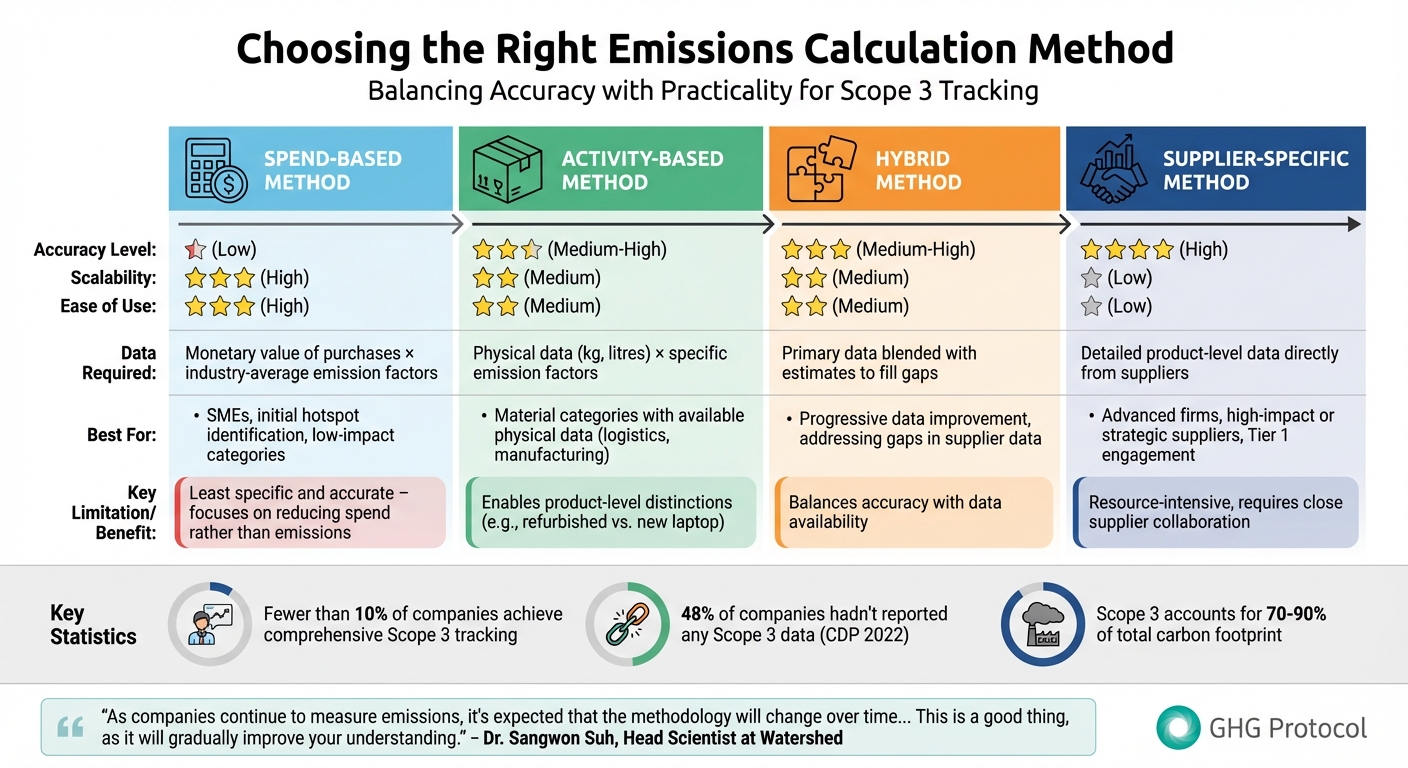
Scope 3 Emissions Calculation Methods Comparison Guide
Choosing the right emissions calculation method involves balancing accuracy with practicality. The GHG Protocol outlines four main methods: spend-based, activity-based, hybrid, and supplier-specific. Each is suited to different organisational needs and levels of data availability.
Spend-based calculations use the monetary value of purchases multiplied by industry-average emission factors. This method is straightforward and helps identify carbon hotspots using accounting data, but it lacks precision. Emitwise explains, "The spend-based method is generally the least specific and accurate of the four calculation methods". A key limitation is its focus on reducing spend rather than enabling smarter, lower-emission purchasing decisions.
Activity-based methods provide a moderate level of accuracy and allow for product-level distinctions. By using physical data - such as kilogrammes or litres - combined with specific emission factors, this approach can differentiate between products like a refurbished laptop versus a new one. However, many companies face challenges in tracking physical quantities consistently across their supply chains, limiting its application.
Hybrid and supplier-specific methods deliver greater accuracy than the other approaches. Hybrid methods blend primary data with estimates to fill information gaps, while supplier-specific methods rely entirely on detailed product-level data from suppliers. This makes supplier-specific calculations highly precise but also resource-intensive, requiring close collaboration with suppliers. Dr. Sangwon Suh, Head Scientist at Watershed, highlights the evolving nature of emissions measurement: "As companies continue to measure emissions, it's expected that the methodology used to calculate footprints will change over time... This is a good thing, as it will gradually improve your understanding of the size of the problem".
For most businesses, starting with spend-based calculations is a practical way to establish a baseline. Over time, they can transition to more accurate methods, especially for material categories. It's worth noting that fewer than 10% of companies achieve comprehensive Scope 3 tracking, largely due to the demanding data requirements of advanced methods.
Comparison Table: Emissions Calculation Methods
| Method | Accuracy | Scalability | Ease of Use | Best For |
|---|---|---|---|---|
| Spend-based | Low | High | High | SMEs, initial hotspot identification, low-impact categories |
| Activity-based | Medium-High | Medium | Medium | Material categories with available physical data (e.g. logistics, manufacturing) |
| Hybrid | Medium-High | Medium | Medium | Progressive data improvement, addressing gaps in supplier data |
| Supplier-specific | High | Low | Low | Advanced firms, high-impact or strategic suppliers, Tier 1 engagement |
How EcoHedge Supports Supplier Scope 3 Emissions Tracking
Core Features and Benefits
EcoHedge takes the complexity out of carbon accounting, especially for businesses without dedicated sustainability teams. By connecting seamlessly with popular UK accounting software, it automates the process of syncing reconciled data and converting spending into CO2 equivalents using official UK Government emission factors.
The platform employs a combination of spend-based and activity-based methods, both aligned with the Scope 3 GHG Protocol. This allows businesses to quickly establish a baseline from financial data and then refine it further for specific categories like energy use or vehicle emissions through targeted prompts. The result? An audit-ready, defensible report in less than an hour. Compared to outdated spreadsheet methods, this is a huge time-saver.
"EcoHedge has been an invaluable asset to my business as we tackle the demands of selling our products to larger corporations. The need for sustainability reports had become a significant roadblock to securing deals, but EcoHedge helped by offering a quick and cost-effective solution".
This testimonial from Elle, a verified user, highlights the platform's real-world impact. Trusted by over 500 UK suppliers, EcoHedge delivers streamlined, audit-ready reports, making it a practical choice for businesses of all sizes. Its flexible pricing structure further enhances its appeal.
Pricing and Accessibility
EcoHedge keeps advanced Scope 3 tracking within reach for small and medium-sized enterprises (SMEs) through its accessible pricing options. The Starter plan, priced at £24/month (£240/year, excluding VAT), provides pay-as-you-go access. Businesses can upload CSV files and generate reports for £199 each. For those needing regular reporting, the Growth plan costs £99/month (£990/year, excluding VAT) and includes unlimited audit-ready reports, direct integration with Xero, team roles, and advanced analytics - making it the choice for 72% of users.
This pricing approach stands in stark contrast to the high fees of enterprise-level platforms or external consultants. It empowers smaller businesses to produce procurement-grade reports independently. As Isabelle puts it:
"Seamlessly integrated software that has made carbon accounting faster and more affordable!".
For accountants and consultants managing multiple clients, the Advisors plan offers custom features like white-label reporting, batch uploads, and a branded portal, enabling scalable Scope 3 tracking across diverse portfolios.
Best Practices for Implementing Supplier Tools
Supplier Segmentation and Prioritisation
To improve Scope 3 tracking, focus your efforts on emission hotspots. These are areas in your supply chain - like power generation, raw materials, or transportation - that contribute the most to your carbon footprint. Prioritising these categories is far more effective than simply targeting suppliers based on spending alone.
Geography plays a crucial role too. Emission levels can vary greatly depending on the country. For example, in the Chinese high-tech sector, 79% of upstream emissions are generated domestically, while the figure is just 46% for the UK and US high-tech industries. Understanding these regional differences helps you decide where to focus your engagement efforts for the greatest impact.
It’s also important to look beyond your direct (Tier 1) suppliers. While they’re easier to contact, they often account for only a small part of your overall emissions. In sectors like high-tech, around 80% of upstream emissions come from Tier 2 and beyond. Engaging with these deeper supply chain layers is essential, often requiring practical strategies to measure and disclose scope 3 emissions.
When planning how to work with suppliers, consider their sustainability maturity. Suppliers with advanced systems can often provide high-quality data right away. On the other hand, those at earlier stages might need more support and may initially rely on spend-based estimates. By tailoring your approach, you can avoid overwhelming less-prepared suppliers while still gathering accurate data from those who are ready.
Once you’ve identified and prioritised suppliers based on their emission impact, it’s essential to keep monitoring their progress and verifying their performance over time.
Monitoring Progress and Ensuring Compliance
Real-time dashboards have revolutionised supplier performance tracking. These tools replace outdated manual spreadsheets with instant insights into data quality, submission rates, and progress towards targets. Ariane Jacoberger, Sustainability and Social Impact Manager at Solinest, highlights the benefits of digital systems:
"With Carbon Maps, we've replaced time-consuming manual processes with a structured digital system that gives us real-time insight into our suppliers' sustainability maturity and initiatives".
To avoid delays, set clear expectations from the start. Define what data you need, establish deadlines, and outline quality standards. Despite this being critical, only 10% of companies currently include climate-related requirements in their supplier contracts. Adding these clauses not only ensures compliance but also holds suppliers accountable. Align your monitoring with annual reporting cycles, like those required by the Science Based Targets initiative (SBTi), to maintain consistency.
Third-party verification is another key step. Independent audits can confirm the accuracy of your emissions data, which is especially important when reporting to regulators or investors. Tools that offer data lineage and confidence scoring can make your reports audit-ready from the outset. This approach strengthens trust among stakeholders while ensuring your data meets the highest standards.
Monitoring performance is just one part of the equation. Ensuring your reporting aligns with regulations is equally important.
Regulatory Alignment and Reporting
UK businesses face a range of reporting frameworks. For example, the Streamlined Energy and Carbon Reporting (SECR) applies to quoted companies, as well as large unquoted companies or LLPs that meet specific criteria: more than 250 employees, a turnover above £36 million, or a balance sheet exceeding £18 million. At the same time, the GHG Protocol Corporate Value Chain (Scope 3) Standard offers a globally recognised method for categorising emissions across 15 categories.
To simplify data collection and ensure consistency, align your reporting boundary with your financial reporting boundary. This can be done using either the equity share approach or the control approach (financial or operational control). Additionally, use official emission conversion factors, like the DESNZ Grid Average in the UK, to convert activity data - such as mileage or energy use - into CO2e.
The "comply or explain" principle allows for transparency with some flexibility. If you’re unable to meet certain reporting requirements immediately, provide a clear explanation and a timeline for when you’ll comply. When using carbon credits, make sure to report them separately from gross emissions. Include details about the volume, type (reduction or removal), and integrity of the credits to maintain clarity.
Conclusion
Tracking Scope 3 emissions has become a critical step for businesses aiming for net-zero goals. On average, supply chain emissions are 11.4 times higher than direct operational emissions, with Scope 3 accounting for around 75% of a company’s total carbon footprint. This makes supplier-focused tools an indispensable part of the process. The EU's Corporate Sustainability Reporting Directive (CSRD) further underscores this by mandating detailed Scope 3 reporting, impacting suppliers of all sizes.
Switching from spend-based estimates to direct supplier data is a key shift. Automated platforms now play a crucial role by integrating publicly available data with inputs directly from suppliers. For smaller businesses, internal accounting costs can climb to about 3% of their revenues. Platforms like EcoHedge simplify this process, making carbon accounting more accessible and efficient.
EcoHedge, for instance, offers automated carbon accounting that integrates with over 20 UK accounting software platforms, starting at just £24 per month (ex VAT). This enables SMEs to generate audit-ready reports and carbon reduction plans across all Greenhouse Gas Protocol scopes. As Emitwise highlights:
"Your ability to collect and share emissions data will become a competitive advantage as businesses seek to meet compliance targets".
To maximise these advancements, combining technology with strategic supplier collaboration is essential. Focus on high-impact suppliers in emission-heavy sectors, provide educational resources to less experienced partners, and approach data collection as a shared commitment to sustainability rather than a compliance burden. With 94% of companies setting science-based targets including Scope 3 emissions in their goals, the challenge now lies in accelerating the adoption of these critical tools.
FAQs
Which Scope 3 categories should I tackle first?
Start by targeting the Scope 3 categories that contribute most to your emissions and can be addressed more readily. Typically, these include purchased goods and services, capital goods, and upstream transportation. Concentrate on areas where gathering data is manageable and where working with suppliers can lead to clear, measurable reductions. By prioritising these high-impact categories, you can create a strong foundation for addressing more challenging emission sources in the future.
How can I get suppliers to share reliable emissions data?
To gather dependable emissions data from suppliers, a cooperative strategy works best. Begin by assessing where each supplier stands in their journey towards tracking emissions - especially focusing on those just starting out. Make the reporting process straightforward by offering clear guidelines and demonstrating how the data aligns with their climate ambitions. Providing practical tools and meaningful incentives can encourage trust and engagement. Additionally, using intuitive platforms for secure, automated data collection can simplify the process. Building strong, collaborative relationships is key to ensuring ongoing and accurate data sharing.
When should I move from spend-based to supplier-specific calculations?
When you need more precise and detailed Scope 3 emissions data, switching to supplier-specific calculations is the way to go. While spend-based methods are useful for initial estimates, supplier-specific data becomes critical as your sustainability objectives evolve or regulatory demands increase. This method allows for accurate tracking at the product or facility level, ensures compliance with regulations, and improves the credibility of carbon reporting by relying on primary data straight from your suppliers.