
How to Measure Franchise Emissions
How to Measure Franchise Emissions
Measuring franchise emissions is about understanding and reporting the carbon output from independently operated franchise locations. These emissions, classified under Scope 3 Category 14 by the Greenhouse Gas Protocol, include energy use, heating, cooling, and fuel consumption at franchise sites. Here's a quick breakdown:
- Why it matters: Franchise emissions often surpass those of the franchisor’s main office, making them vital to track for regulatory compliance and sustainability goals.
- What’s included: Scope 1 (direct emissions like fuel and refrigerants) and Scope 2 (indirect emissions from electricity and heating) of franchisees.
- Challenges: Franchisors face hurdles like inconsistent data, limited control, and outdated franchise agreements.
- Steps to measure:
- Define boundaries (equity share or control approach).
- Choose a calculation method (spend-based, average-data, or franchise-specific).
- Collect data (utility bills, energy use, etc.).
- Calculate emissions using reliable emission factors.
- Tools like EcoHedge: Automate data collection, improve accuracy, and simplify reporting.
Tracking these emissions not only ensures compliance with evolving regulations like the EU's CSRD but also helps franchisors identify opportunities for reduction and improve transparency with stakeholders.
How to Calculate Your COMPANY'S Carbon Footprint (Step-by-Step Guide!)
sbb-itb-919600f
The Greenhouse Gas Protocol for Franchise Emissions
The Greenhouse Gas Protocol, developed by the World Resources Institute (WRI) and the World Business Council for Sustainable Development (WBCSD), is one of the most widely recognised frameworks for tracking and managing greenhouse gas emissions. It offers standardised methods for organisations to measure their emissions, define boundaries, and categorise them across three distinct scopes. For franchisors, this framework is particularly relevant as it includes emissions generated outside their direct operations but still linked to their brand or value chain.
Franchise emissions are categorised under Scope 3 Category 14, which requires franchisors to account for the Scope 1 and 2 emissions of their franchisees. This classification exists because, while franchisees operate independently, they do so under the franchisor's brand or licence. Sahil Khare from Sprih explains:
The GHG Protocol directs franchisors to account for the Scope 1 and 2 emissions of their franchisees in this category. Even if the franchisor doesn't operate those facilities, the brand association makes the emissions part of the corporate value chain.
The protocol is undergoing its first major revision in years, with updated standards expected by 2026–2027. This update aligns with the increasing shift from voluntary reporting to mandatory disclosure, driven by regulations such as California's SB 253 and the EU's Corporate Sustainability Reporting Directive (CSRD). These evolving standards provide the foundation for the measurement processes discussed in later sections.
Scope 3 Emissions Explained
Scope 3 emissions cover all indirect emissions throughout a company’s value chain, both upstream (e.g., suppliers) and downstream (e.g., product use). For many organisations, these emissions make up a staggering 70–90% of their total greenhouse gas footprint. The Science Based Targets initiative (SBTi) requires companies to set Scope 3 reduction targets if these emissions exceed 40% of their total footprint.
For franchisors, Scope 3 Category 14 specifically accounts for the Scope 1 and 2 emissions of their franchisees, such as energy consumption, refrigerants, and fuel usage. In large franchise networks - especially in industries like quick-service restaurants, hospitality, retail, and automotive services - these emissions often surpass the franchisor's direct operational emissions.
Managing these emissions effectively often requires franchisors to introduce centralised carbon reporting systems and revise franchise agreements to include provisions for energy and emissions reporting. This process can be complex and is further explored below.
Scope 3 Category 14 Characteristics
Measuring franchise emissions presents unique challenges due to limited direct control and inconsistent reporting practices. Franchisees typically oversee their own utility contracts, equipment choices, and operational practices, which creates significant data gaps across regions with varying energy sources and regulations.
Many older franchise agreements lack clauses requiring environmental reporting, making it difficult to gather historical data. To address this, franchisors often need to update contracts to include sustainability requirements, such as mandatory data sharing and minimum efficiency standards for HVAC systems, lighting, and refrigeration equipment. Without a unified reporting system, franchisors are left to piece together fragmented data from independent operators using diverse accounting methods and regional standards.
| Scope 3 Category 14 Characteristics | Description |
|---|---|
| Applicability | Franchisors (licensors) reporting on franchisees (independent operators) |
| Emissions Included | Scope 1 and 2 emissions of franchisees, such as energy use, refrigerants, and fuels |
| Primary Challenges | Limited control, data visibility gaps, and inconsistent reporting across regions |
| Key Industries | Food & Beverage, Hospitality, Retail, and Automotive service networks |
The Greenhouse Gas Protocol outlines four methods for calculating emissions, each with different levels of accuracy. These include supplier-specific data (most accurate but hardest to obtain), hybrid methods, average-data approaches, and spend-based calculations (easiest but less precise). Most franchisors start with spend-based calculations for an initial overview and then progress to activity-based data for locations with the highest emissions. Choosing the right method is critical for building an accurate emissions inventory and guiding further action.
How to Measure Franchise Emissions
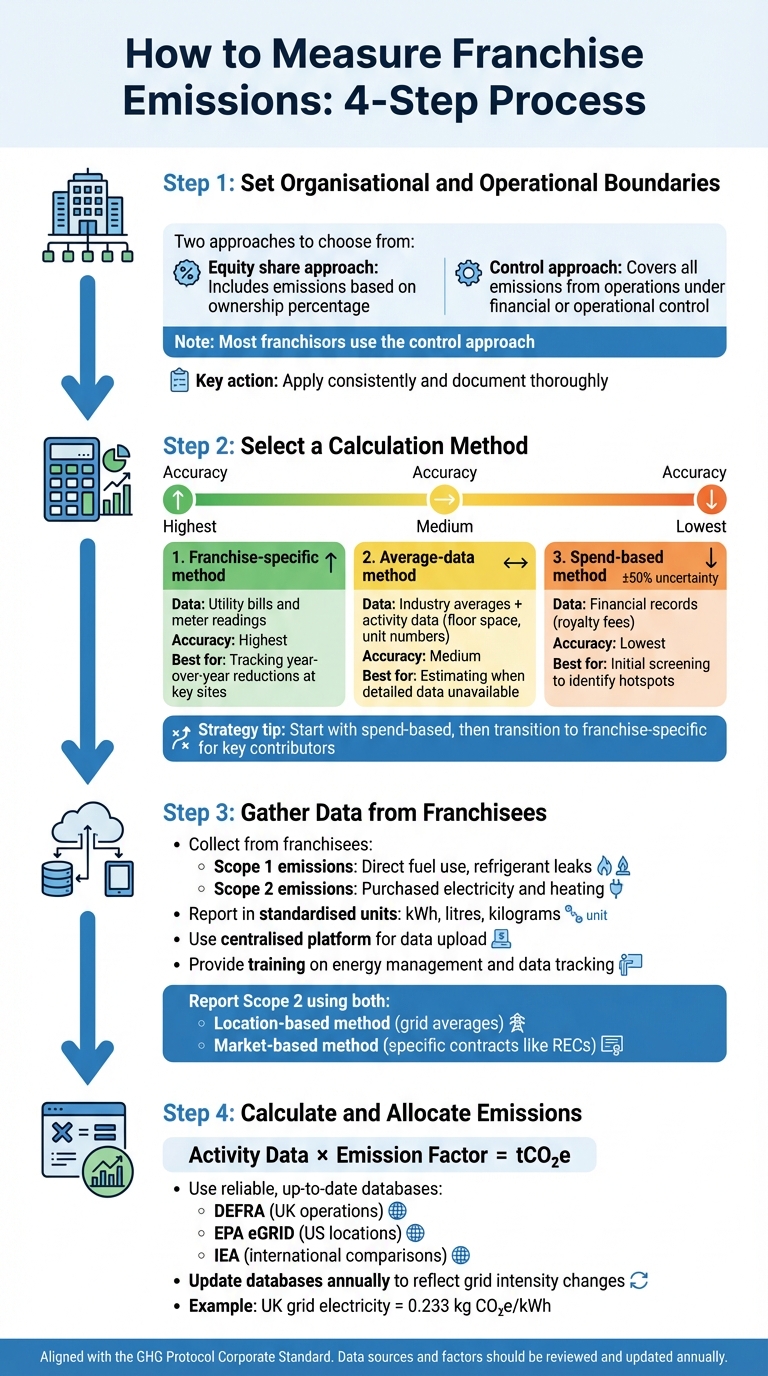
4-Step Process to Measure Franchise Emissions Under GHG Protocol
Measuring franchise emissions requires a clear, structured method. It’s about balancing the technical guidelines of the Greenhouse Gas Protocol with the practicalities of working with independent operators in various locations. Here’s how to tackle it step by step.
Step 1: Set Organisational and Operational Boundaries
Before diving into data collection, franchisors need to decide which emissions to include. The Greenhouse Gas Protocol outlines two approaches for this:
- Equity share approach: Includes emissions based on ownership percentage.
- Control approach: Covers all emissions from operations under financial or operational control.
For most franchisors, the control approach works better. Even though franchisees run independently, the brand connection and licensing agreements create a shared responsibility for these emissions. Whichever approach you choose, make sure it’s applied consistently and documented thoroughly.
Once the boundaries are set, move on to choosing the right greenhouse gas emissions accounting method.
Step 2: Select a Calculation Method
The next step is deciding how to calculate emissions, balancing data availability with accuracy. Here are the three main methods to consider:
- Franchise-specific method: This involves collecting utility bills and meter readings from each location. It’s the most accurate but also the most resource-intensive.
- Average-data method: This uses industry-average emission factors applied to activity data like floor space or unit numbers. It’s less precise but useful when detailed data isn’t available.
- Spend-based method: This multiplies financial data (e.g. royalty fees) by economic emission factors. It’s a quick starting point but comes with a high uncertainty range (±50%).
A good strategy is to start with the spend-based method to identify hotspots, then transition to more detailed franchise-specific data for key contributors.
Now, it’s time to gather the data needed for these calculations.
Step 3: Gather Data from Franchisees
Collecting data from franchisees can be tricky, but it’s essential. Franchisees should report their Scope 1 emissions (like direct fuel use and refrigerant leaks) and Scope 2 emissions (purchased electricity and heating). To streamline this:
- Use a centralised platform where franchisees can upload standardised data, such as kWh, litres, or kilograms.
- Provide training on energy management and data tracking to improve compliance and data reliability.
For Scope 2 emissions, franchisees should report using both the location-based method (grid averages) and the market-based method (specific contracts like Renewable Energy Certificates).
Once the data is in, you can move on to the actual calculations.
Step 4: Calculate and Allocate Emissions
To calculate emissions, multiply the activity data by the relevant emission factor (measured in tCO₂e). These factors translate physical activities, like electricity use in kilowatt-hours, into carbon dioxide equivalents. Since emission factors vary by region and energy source, it’s important to use reliable, up-to-date databases such as:
Make sure to update these databases annually to reflect changes in grid intensity.
Here’s a quick comparison of the three methods:
| Method | Data Required | Accuracy Level | Best Use Case |
|---|---|---|---|
| Franchise-specific | Actual utility bills and meter readings | Highest | Tracking year-over-year reductions at key sites |
| Average-data | Activity data (e.g. floor space) | Medium | Estimating impacts when detailed data isn’t available |
| Spend-based | Financial records (e.g. royalty fees) | Lowest | Initial screening to identify emission hotspots |
Reporting and Verifying Franchise Emissions
Once you've calculated your franchise emissions, the next step is to create a report that complies with GHG Protocol standards. A well-prepared report not only ensures transparency but also strengthens trust with investors, customers, and regulators.
Emission Reporting Best Practices
The Greenhouse Gas Protocol outlines five key principles for emissions reporting: relevance, completeness, consistency, transparency, and accuracy. Your report should include:
- Total emissions (measured in tCO₂e)
- Methods used for calculations
- Sources of emission factors
- Clear explanations for any excluded Scope 3 categories
If certain Scope 3 categories are omitted, provide a thorough justification - auditors will want to see this. Additionally, establish a base year to track performance over time and set a recalculation policy for significant changes, such as acquiring new franchise locations or correcting major errors in previous data.
For Scope 2 emissions, report figures using both the location-based method (based on grid averages) and the market-based method (reflecting renewable energy contracts). Since grid carbon intensity can change frequently, it's important to update emission factors annually to avoid introducing errors from outdated data.
"Understanding the GHG Protocol is not optional for any organisation engaged in climate disclosure." - Council Fire
By adhering to these practices, your internal reporting will meet high standards. The next step is to ensure the data is verified externally.
Third-Party Verification
Once your internal report is complete, seek external verification. This step boosts credibility and reduces the risk of greenwashing. Many major frameworks now require verified emissions inventories, making this process increasingly important.
Before engaging with third-party auditors, review your data thoroughly. Compare current figures with previous reports and reconcile bottom-up calculations with top-down estimates. This preparation helps avoid common mistakes, such as inconsistent organisational boundaries or selective reporting of Scope 3 categories, and ensures a smoother and more cost-effective external audit process.
Using EcoHedge for Franchise Emission Tracking
Tracking and reporting emissions manually can be a daunting and time-consuming task. To simplify this process, many franchisors are now opting for automated tools like EcoHedge. This platform eliminates much of the manual effort, streamlining compliance with Scope 3 Category 14 requirements. By automating data processing, EcoHedge aligns with the GHG Protocol's guidelines, transforming raw data into actionable insights quickly and efficiently.
How EcoHedge Simplifies Carbon Accounting
EcoHedge connects seamlessly with accounting platforms such as QuickBooks and Xero, pulling purchase invoices and energy bills directly from these systems to calculate emissions. For franchise networks, it gathers site-specific data like fuel consumption (in litres), electricity usage (in kWh), and gas data via API connections. The software then applies UK-specific emission factors - for example, 0.233 kg CO₂e/kWh for grid electricity - to deliver precise calculations. This automation reduces manual data entry errors by as much as 80%, making it easier to collect data even from franchisees without prior reporting systems.
The platform also addresses complex scenarios, such as franchises in shared buildings. For example, EcoHedge can allocate emissions accurately for multi-tenant high street locations in the UK, avoiding overestimations. It also supports the average-data method, which uses information from sampled locations to estimate emissions across larger networks. This is particularly useful when collecting data from every site isn't practical. All this data feeds into EcoHedge's customisable dashboards and tools, offering a clear picture of emissions across the franchise network.
EcoHedge Features for Franchise Emissions
EcoHedge provides detailed dashboards and PDF reports that comply with GHG Protocol standards. These reports break down emissions by franchise group and display totals in tCO₂e, using metric units (m², kWh), UK date formats (DD/MM/YYYY), and GBP for costs. This makes the reports ready for third-party verification. In one Scope 3 case study, the platform helped achieve significant emissions reductions, which played a key role in retaining important contracts.
Beyond just reporting, EcoHedge includes tools for planning carbon reduction strategies. Features like heatmaps help identify high-emission franchises, while scenario modelling demonstrates how energy-efficient upgrades could lead to reductions of 20–30%. With its integration across more than 20 accounting applications and automated categorisation into Scope 1, 2, and 3 emissions, EcoHedge not only simplifies compliance with CSRD requirements but also strengthens communication with stakeholders and empowers franchisors to reduce emissions across their entire network.
Conclusion
Tracking franchise emissions has become a critical step for businesses aiming to operate responsibly. With regulations like the EU's CSRD and California's SB 253 requiring value chain emissions reporting, franchisors must act promptly to ensure compliance and protect their brand reputation.
Regulations highlight the importance of precise emissions measurement. While spend-based estimates offer a quick way to locate problem areas, activity-based data provides the detail needed for effective monitoring and reduction strategies.
Solutions such as EcoHedge streamline this process by automating data collection, applying accurate emission factors, and generating audit-ready reports. For example, in 2026, a medical device supplier used EcoHedge to discover that manufacturing accounted for 52% of their emissions. This insight allowed them to create a reduction plan, helping them retain NHS contracts worth £1.2 million. This case study underscores the practical advantages of automated tools.
To move towards net-zero carbon accounting, immediate action is crucial. Update franchise agreements to include sustainability reporting clauses, centralise data collection with digital dashboards, and provide franchisees with energy management training, as outlined in the earlier steps. As Sprih aptly states:
Franchise sustainability is brand sustainability.
FAQs
Do I have to report franchise emissions under Scope 3 Category 14?
Yes, emissions from franchises must be reported under Scope 3 Category 14 if they are part of your value chain and aren't already included in Scope 1 or Scope 2. This category focuses on emissions generated by franchise operations linked to your brand.
Which calculation method should I start with if franchise data is limited?
If franchise data is hard to come by, you can begin with the simplified calculation method outlined in the GHG Protocol Scope 3 guidance for SMEs. This approach zeroes in on major emission categories and relies on estimates or proxy data when exact figures aren't available. It’s a practical way to set up a baseline for reporting, enabling you to collect data gradually and improve reporting detail over time - even if you don’t have access to detailed franchise-specific data at the start.
How can I get franchisees to share consistent energy and fuel data?
To maintain consistent energy and fuel data across franchisees, it's crucial to embed emissions responsibility throughout your network and set up clear reporting protocols. Start by using standardised data collection processes and offering training or tools to help franchisees manage this effectively. Transparency should also be encouraged at every level.
For a smoother approach, consider solutions like EcoHedge, which provides automated carbon accounting tools to simplify data sharing. Additionally, setting clear expectations, maintaining regular communication, and incorporating reporting requirements into contracts or daily operations can significantly enhance consistency across the board.