
How Carbon Reduction Plans Affect Supplier Selection

How Carbon Reduction Plans Affect Supplier Selection
Carbon reduction plans (CRPs) are now a key factor in supplier selection. Businesses bidding for UK government contracts over £5 million annually must have a published CRP, and similar requirements are emerging across industries. These plans focus on reducing emissions, especially Scope 3 emissions, which often account for 70-90% of a company’s carbon footprint. Suppliers without clear emissions data or reduction strategies risk losing contracts to more transparent competitors.
Key Takeaways:
- Mandatory CRPs: Required for large UK government contracts and increasingly for private sector deals.
- Scope 3 Emissions: Indirect emissions from supply chains are a major focus.
- Supplier Evaluation: Companies now prioritise carbon metrics, with environmental performance often making up 20-30% of supplier scoring.
- SME Challenges: Small businesses face hurdles like data collection, cost management, and understanding carbon accounting methodologies.
- Tools Available: Platforms like EcoHedge simplify carbon data collection and compliance for SMEs, starting at £24/month.
Carbon-focused procurement is reshaping business relationships, with transparency and emissions data becoming non-negotiable for suppliers.
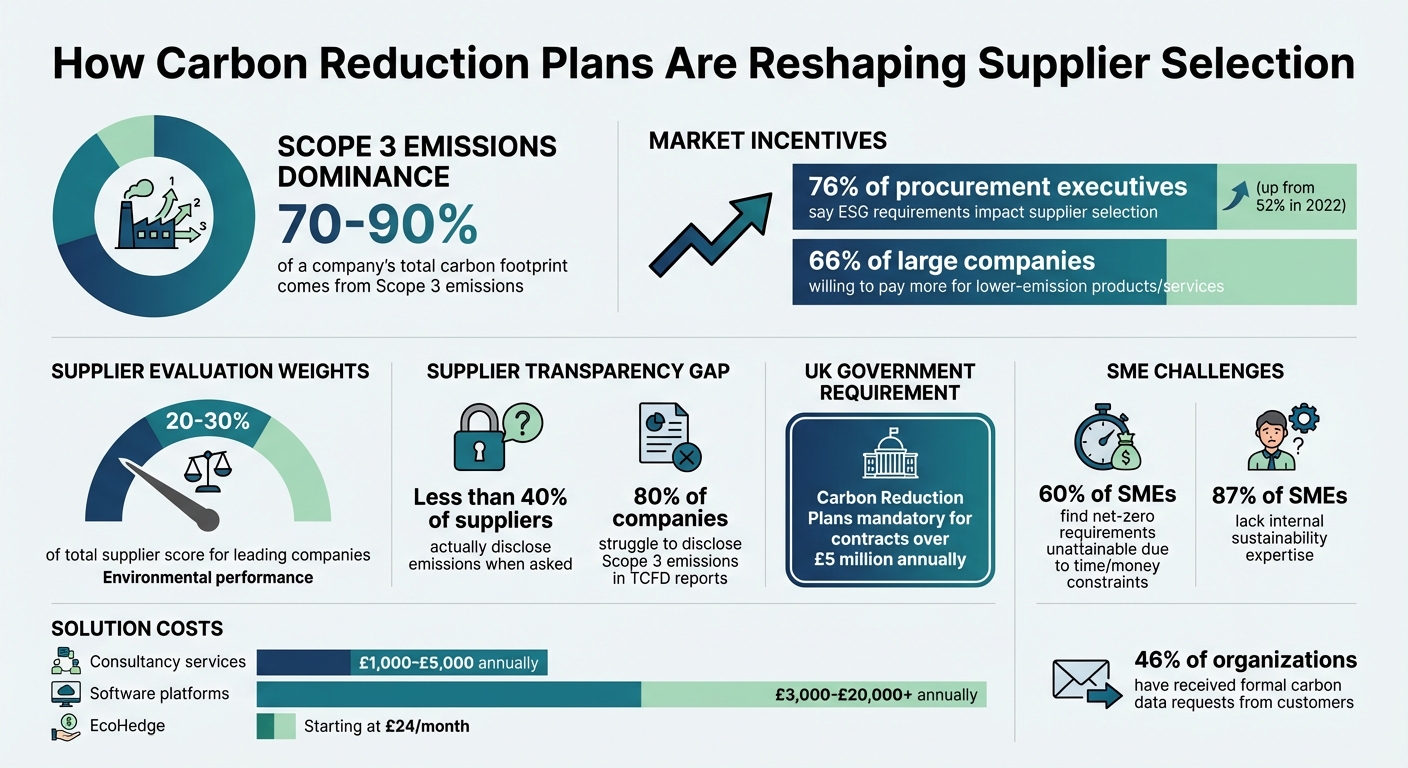
Carbon Reduction Plans Impact on Supplier Selection: Key Statistics and Requirements
How Carbon Reduction Plans Shape Supplier Selection
Choosing Suppliers with Lower Carbon Footprints
The shift towards carbon reduction in procurement is no longer optional - it's now essential. This is largely because Scope 3 emissions, which include indirect emissions from a company’s value chain, account for a staggering 70% to 90% of a company’s total carbon output. As a result, major players like Microsoft, Apple, and Walmart are now excluding suppliers from tender processes if they fail to provide an up-to-date greenhouse gas emissions profile and a clear reduction plan.
Marybeth Collins from Environment + Energy Leader highlights this shift:
Scope 3 is no longer neutral infrastructure. It is actively reshaping supplier power dynamics, influencing who can push back on pricing, who absorbs volatility, and who controls the narrative.
This growing focus on emissions has led procurement teams to prioritise suppliers with lower carbon footprints. These efforts are directly tied to companies’ net-zero goals, making measurable carbon metrics a central part of supplier evaluations.
Adding Carbon Metrics to Supplier Evaluation
To align with these priorities, many organisations now include environmental performance as a key factor in supplier scoring. For leading companies, this can make up 20% to 30% of the total score. Buyers are demanding detailed emissions data, validated Science Based Targets, and third-party verified Product Carbon Footprints as standard requirements rather than optional extras.
Take Taiwan Semiconductor Manufacturing Company (TSMC) as an example. From January 2025, TSMC will incorporate carbon reduction performance into its supplier selection criteria. Suppliers contributing the most to emissions will be required to sign the "Greenhouse Gas Reduction, Emissions Elimination & Neutrality (GREEN) Agreement." By the end of 2026, these suppliers must also secure third-party verification of their product carbon footprints. To aid this transition, TSMC has introduced a subsidy programme, allocating NT$84 million in grants for energy-saving equipment.
Vanessa Lee, TSMC’s Vice President of Materials Management, emphasises the importance of these efforts:
Suppliers' achievements and proactive planning in carbon reduction are key factors for TSMC in partner selection and procurement decisions.
Automated carbon accounting tools are also playing a growing role, helping procurement teams streamline compliance and monitor performance effectively.
Why Supplier Transparency Matters
Transparency from suppliers is critical because a buyer’s ability to report accurate Scope 3 emissions hinges entirely on the data provided by its suppliers. Yet, fewer than 40% of suppliers asked to disclose their emissions actually do so. This lack of transparency poses serious challenges for organisations striving to comply with frameworks like the EU’s Corporate Sustainability Reporting Directive.
The commercial impact is clear. Suppliers with robust, verified emissions data often hold a stronger position, being two to three times more likely to be large multinationals. These suppliers can justify price adjustments and maintain negotiation leverage. On the other hand, suppliers that fail to provide clear data may face stricter contract terms or even disqualification. As Marybeth Collins succinctly puts it:
The contracts will follow the data. The suppliers who can provide it are already pulling ahead.
sbb-itb-919600f
Challenges SMEs Face with Sustainable Procurement
Getting Carbon Data from Suppliers
One of the toughest hurdles SMEs face is gathering reliable carbon data from their suppliers. Suppliers often provide inconsistent or incomplete information, and responding to repeated, non-standardised requests from multiple clients can lead to "supplier fatigue". Many smaller suppliers lack the systems, funding, or technical know-how to accurately measure their carbon footprint. At the same time, SMEs frequently don’t have the dedicated staff needed to collect and analyse Scope 3 emissions data - emissions that can account for up to 90% of a company’s total carbon output. This lack of reliable data is a widespread issue, with 80% of companies compiling TCFD reports struggling to disclose Scope 3 emissions for this reason.
Michael Lengahan, Associate Director at Anthesis, sums up the challenge succinctly:
You can't manage what you can't measure.
These difficulties in data collection only add to the financial and technical barriers SMEs already face.
Managing Costs Alongside Sustainability Goals
For SMEs, balancing sustainability efforts with financial constraints can feel like an uphill battle. About 60% of SMEs report that meeting net-zero requirements seems unattainable due to limits on time and money. Sustainable suppliers often charge higher prices, forcing smaller businesses to choose between cutting emissions and maintaining financial stability.
That said, there’s a growing business incentive to invest in sustainability. Two-thirds of large companies (66%) are willing to pay more for products and services with lower emissions. This means that sustainable practices can open doors to new contracts and strengthen relationships with existing clients. SMEs can also start small by adopting cost-effective measures like switching to renewable electricity providers or improving energy efficiency. These steps can help reduce emissions without breaking the bank.
For SMEs lacking internal expertise - 87% fall into this category - outsourcing can be a practical solution. Many opt for consultancy services, which typically cost between £1,000 and £5,000 annually, as opposed to investing in software platforms that can range from £3,000 to over £20,000 per year—carbon accounting costs that vary based on the level of support required. However, the tension between affordability and sustainability continues to complicate the path forward, particularly when it comes to navigating carbon accounting standards.
Understanding Carbon Accounting Standards
The technicalities of carbon accounting standards can overwhelm SMEs, especially when trying to differentiate between Scope 1 (direct emissions), Scope 2 (indirect energy emissions), and Scope 3 (value chain emissions) without a dedicated sustainability team. Nearly half of all organisations (46%) have already faced formal requests for carbon data from customers, but most SMEs struggle to provide accurate responses.
The challenge becomes even more complex when suppliers use varying reporting frameworks - or none at all - making it difficult to compare emissions data on an equal footing. To meet audit requirements, data must be recent (ideally less than three years old), region-specific, and tailored to the sector. SMEs also face a methodological choice: while a spend-based approach is easier to implement, it’s less precise than an activity-based method, which depends on detailed supplier data that is often unavailable.
As Emitwise points out:
For suppliers, remember: you are your customers' Scope 3 emissions. Your ability to collect and share emissions data will become a competitive advantage.
This highlights how critical supplier transparency is for effective carbon reduction strategies.
Tools That Simplify Carbon-Based Supplier Selection
Automated Carbon Accounting with EcoHedge
EcoHedge offers automated carbon accounting software tailored for SMEs, making it easier to meet modern procurement demands. The tool gathers Scope 3.1 "Purchased Goods and Services" emissions data using precise activity-based metrics like kilowatt-hours (kWh) or litres. When supplier-specific data isn’t available, it relies on spend-based methods, supplemented by industry-average emission factors from trusted sources like DEFRA, Ecoinvent, and co2emissiefactoren.nl. With integration into over 20 accounting platforms and pricing starting at just £24 per month (excluding VAT), EcoHedge ensures carbon accounting is within reach for businesses of varying scales. The collected data seamlessly integrates with EcoHedge’s advanced analysis tools, providing a streamlined solution.
Using Emissions Data for Supplier Decisions
Once emissions data is collected, EcoHedge helps businesses pinpoint high-impact suppliers by analysing factors like spend, criticality, and activity in sectors with significant emissions, such as manufacturing and logistics. The platform tracks essential metrics, including:
- Energy consumption (kWh)
- Fuel usage (litres)
- Total emissions (CO₂e)
- Weight of shipped goods
- Overall service expenditure
This approach allows businesses to start small, focusing on their top 10–20 suppliers, before scaling up their efforts. As Max from Hedgehog’s Writing & Research team puts it:
Effective supplier engagement for scope 3 data is more than a reporting exercise; it is a fundamental part of building a modern, resilient business.
Meeting Sustainability Reporting Requirements
EcoHedge doesn’t stop at data collection and analysis - it also supports compliance with sustainability reporting standards. As organisations increasingly face formal carbon data requests, meeting frameworks like the Corporate Sustainability Reporting Directive (CSRD), the EU Taxonomy, and Digital Product Passports becomes crucial. EcoHedge aligns with these global standards and adheres to the GHG Protocol, ensuring emissions are categorised correctly across Scopes 1, 2, and 3. This allows SMEs to confidently respond to client inquiries and tender requirements for carbon transparency.
To further simplify supplier engagement, EcoHedge provides user-friendly templates and surveys. For more complex challenges, expert consulting services are available, transforming what might seem like an overwhelming task into a manageable process.
Conclusion
Practical Steps for SMEs
Small and medium-sized enterprises (SMEs) can streamline the integration of carbon reduction plans into their supplier selection process. Start by establishing a baseline for Scope 1, Scope 2, and the five mandatory Scope 3 categories outlined under PPN 006. Focus your initial data collection efforts on the top 10–20 suppliers based on spend or those operating in high-emission sectors like manufacturing and logistics.
To formalise your approach, create a Carbon Reduction Plan signed by senior leadership and make it publicly accessible. Not only does this align with UK government requirements for contracts over £5 million, but it also enhances your credibility with potential clients. When working with suppliers, request standardised metrics such as emissions intensity ratios (e.g., tonnes of CO₂e per £m turnover). For suppliers without a carbon accounting process, begin with spend-based estimates using industry averages and gradually transition to activity-based data.
Consider tools like EcoHedge, which can simplify the process with automated data collection, analysis, and compliance-ready reporting. Starting at just £24 per month (excluding VAT), it integrates with over 20 accounting platforms and supports frameworks like PPN 006, CSRD, and the GHG Protocol. These steps provide a solid foundation for adapting procurement practices to meet evolving regulations.
The Future of Carbon-Conscious Procurement
Carbon disclosure is no longer optional in both public and private sectors. In fact, 76% of procurement executives now say that ESG requirements directly impact supplier selection, a notable increase from 52% in 2022. This momentum will only grow as frameworks like the Procurement Act 2023 and CSRD expand. As regulations tighten, market leaders will be those who proactively develop their suppliers. Suppliers unable to show credible carbon reduction efforts risk being excluded from tender opportunities.
Forward-thinking organisations are reframing carbon reduction as a collaborative effort. As SourcingTomorrow notes:
The organizations winning on ESG aren't the ones with the strictest policies. They're the ones who turned their sustainability standards into a supplier development program.
WSPD 2025 - Planet - Scope 3: How Supplier Engagement Can Drive Scope 3 Emission Reduction?
FAQs
Do we need a published Carbon Reduction Plan to win contracts?
A Carbon Reduction Plan is often a must-have for businesses aiming to bid on major government contracts in the UK. This document isn't just a formality - it holds weight in the procurement assessment process. By requiring it, the government ensures that suppliers are aligned with its broader sustainability objectives, encouraging responsible environmental practices.
What Scope 3 data do buyers expect from suppliers?
Buyers often look to suppliers for primary data on Scope 3 emissions. This data includes both upstream and downstream carbon footprint details, enabling buyers to better assess and manage their indirect emissions. Providing accurate and transparent reports plays a key role in meeting sustainability targets and fostering stronger collaboration with suppliers.
How can an SME start measuring supplier emissions quickly?
To measure supplier emissions efficiently, small and medium-sized enterprises (SMEs) should prioritise gathering data for Scope 3.1, which covers "Purchased Goods and Services". Begin by reaching out to suppliers and requesting emissions information through surveys or standardised questionnaires. Practical tools like checklists and guides can help organise the process and ensure it aligns with UK-specific regulations, such as PPN 006 for government contracts. Additionally, consultancy services can assist with data collection and reporting, making the process quicker and more manageable.