
Carbon Legislation Timeline: UK vs. EU
Carbon Legislation Timeline: UK vs. EU
The UK and EU have approached carbon legislation differently, especially post-Brexit. Here's what you need to know:
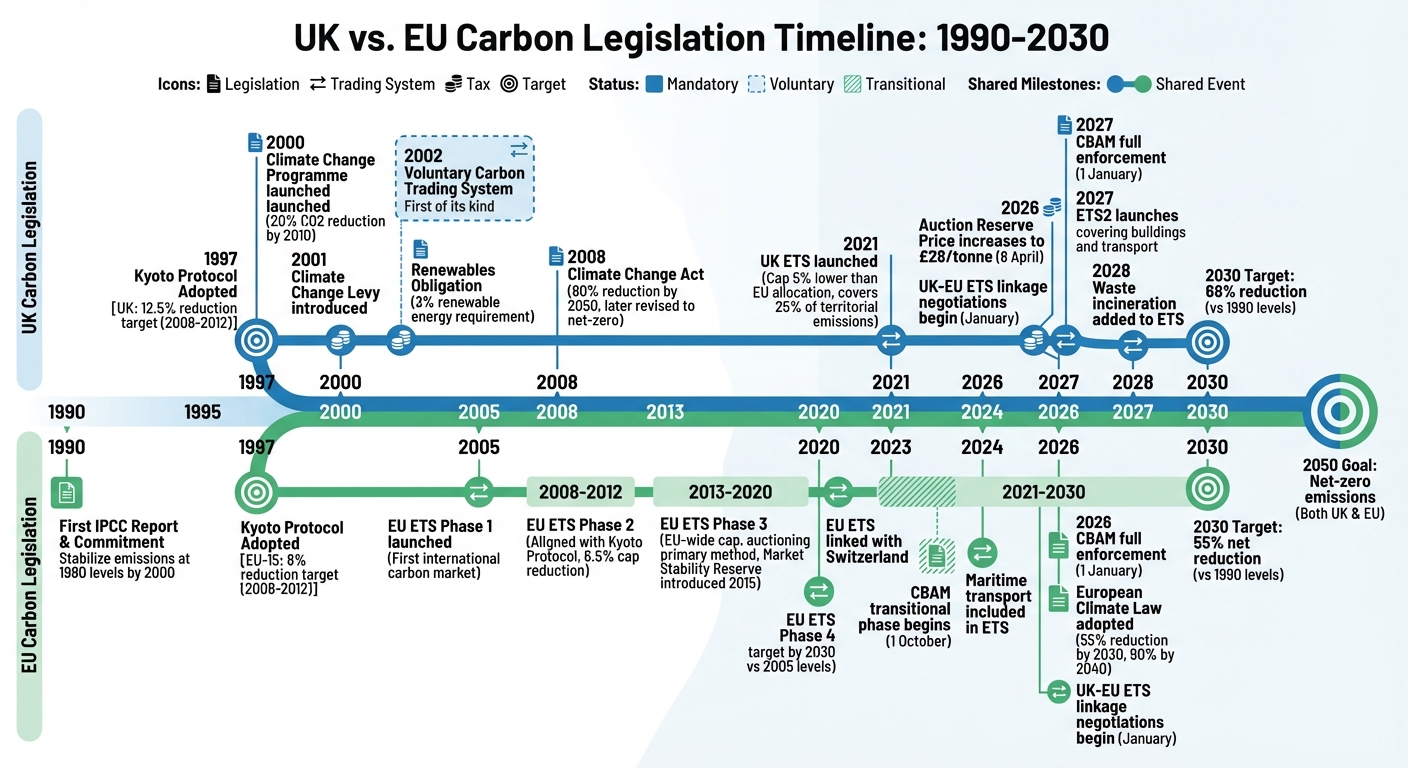
- The UK introduced a voluntary carbon trading system in 2002, while the EU launched its mandatory Emissions Trading System (ETS) in 2005.
- After Brexit, the UK established its own ETS in 2021, with an emissions cap 5% lower than its EU allocation.
- The EU's Carbon Border Adjustment Mechanism (CBAM) starts full enforcement on 1 January 2026, while the UK's version begins a year later, on 1 January 2027.
- EU CBAM includes electricity, while the UK adds sectors like glass and ceramics. reporting and compliance requirements also differ between the two systems.
- The UK and EU are working towards linking their ETS systems, with formal negotiations starting in January 2026.
For businesses, these differences affect compliance, costs, and reporting requirements. SMEs must prepare for varying rules across both regions. Utilizing carbon accounting platform essentials can help manage these complex regulatory shifts.
UK vs EU Carbon Legislation Timeline 1990-2030
Early Carbon Legislation: 1990s to Early 2000s
Kyoto Protocol and Early Commitments
The 1990s marked the beginning of coordinated global efforts to tackle climate change. After the first IPCC report in 1990, EU leaders committed to stabilising greenhouse gas emissions at 1990 levels by the year 2000. This early pledge set the groundwork for the more ambitious targets laid out in the Kyoto Protocol, which was adopted in 1997.
Both the EU and the UK were instrumental in shaping the Protocol. At COP 1, they were key in establishing the "Berlin Mandate", which acknowledged the historical responsibility of developed nations to lead the way in reducing emissions. Acting as a unified bloc, the EU-15 committed to cutting greenhouse gas emissions by 8% between 2008 and 2012. The UK took on an even more ambitious target, agreeing to a 12.5% reduction to support the EU's collective goal.
"The Protocol was based on the principle of common but differentiated responsibilities: it acknowledged that individual countries have different capabilities in combating climate change." – Wikipedia
However, not all efforts were aligned. In 1992, the European Commission proposed a community-wide CO2 and energy tax. The UK, leading a coalition of dissenting member states, blocked the initiative, opting instead for national-level solutions. This disagreement hinted at the distinct paths the UK and EU would later take regarding carbon pricing.
These early agreements laid the foundation for the carbon pricing strategies that each region would eventually implement.
Carbon Pricing Initiatives
By 2000, both the UK and the EU had introduced climate-focused programmes building on their earlier commitments. The UK launched its Climate Change Programme with a goal of reducing CO2 emissions by 20% by 2010 - far exceeding its Kyoto target of 12.5%. Meanwhile, the European Climate Change Programme (ECCP) began laying the groundwork for the EU Emissions Trading System (EU ETS), which would come into effect in 2005.
The UK acted quickly with domestic measures. In 2001, it introduced the Climate Change Levy, a tax on energy use targeting businesses and the public sector. This was followed by the Renewables Obligation in 2002, which required electricity suppliers to source 3% of their power from renewable energy, with this figure set to rise to 15.4% by 2015–2016. That same year, the UK also launched a voluntary carbon trading system - the first of its kind - which served as a model for the mandatory EU ETS introduced in 2005.
Both the UK and the EU pursued a three-pronged approach: cutting greenhouse gas emissions, promoting renewable energy, and improving energy efficiency. However, their methods diverged. The UK leaned towards a mix of taxation and market-based obligations, while the EU opted for a centralised cap-and-trade system after rejecting a unified tax approach.
sbb-itb-919600f
UK Carbon Legislation Milestones
The Climate Change Act (2008) and Carbon Budgets
In 2008, the UK took a major step in tackling greenhouse gas emissions by introducing the Climate Change Act. This legislation set a legally binding target to reduce emissions by 80% by 2050 compared to 1990 levels. In 2019, this goal was revised to aim for net-zero emissions by 2050. This shift necessitates robust carbon accounting for businesses to track progress accurately.
A key feature of the Act is the introduction of economy-wide carbon budgets. These are legally binding, five-year caps on emissions, designed to keep the UK on track. For instance, the fourth carbon budget targets a 50% reduction in emissions from 1990 levels by 2025. To ensure accountability, the Act also established the independent Committee on Climate Change, tasked with monitoring progress and offering advice. Unlike the EU's sector-specific reliance on the EU ETS, the UK's carbon budgets provide a broader strategy with clear, measurable goals.
This framework laid the groundwork for the UK's subsequent reforms to its trading system following Brexit, aligning it more closely with domestic goals.
Transition from EU ETS to UK ETS
After Brexit, the UK launched its own Emissions Trading Scheme (UK ETS) on 1 January 2021. To demonstrate its commitment to cutting emissions, the UK set the initial cap 5% lower than the EU's equivalent scheme.
The UK ETS covers around 25% of the country's territorial emissions, focusing on heavy industry, power generation, and aviation. Several updates have been introduced to strengthen the scheme. For example, on 8 April 2026, the Auction Reserve Price will increase from £22 to £28 per tonne. The system also includes a Cost Containment Mechanism to manage price spikes and is set to expand its coverage. From July 2026, maritime transport will be included, followed by waste incineration in 2028.
In a significant move towards collaboration, the UK and EU agreed in May 2025 to explore linking their respective trading schemes, with formal negotiations starting in November 2025. This potential alignment could enhance the effectiveness of both systems while maintaining the UK's focus on its own priorities.
EU Carbon Legislation Milestones
Phases of the EU ETS
The EU Emissions Trading System (EU ETS), launched in 2005, was the first international carbon market of its kind. Phase 1 (2005–2007) served as a test run, laying the groundwork for monitoring emissions and trading allowances across EU member states. Trading volumes saw a sharp rise, from 321 million in 2005 to 2.1 billion in 2007. However, the phase ended with a price crash - carbon prices, which peaked at about €30 per tonne in April 2006, dropped to nearly zero by September 2007 due to over-allocation of allowances[21,23].
Phase 2 (2008–2012) aligned with the Kyoto Protocol's first commitment period. During this phase, the emissions cap was reduced by 6.5% compared to 2005 levels. Aviation was also brought into the system, and penalties for non-compliance were raised significantly - from €40 to €100 per tonne[23,24].
Phase 3 (2013–2020) introduced a major overhaul. The system moved from national caps to a single EU-wide limit, and auctioning became the primary method for allocating allowances instead of free distribution. To address surplus allowances and stabilise prices, the Market Stability Reserve was introduced in 2015[23,24].
Phase 4 (2021–2030) is targeting a 62% reduction in emissions by 2030 compared to 2005 levels. Maritime transport will be included from January 2024, and free allowances will be completely phased out. Between 2013 and 2025, the system is expected to generate over €245 billion in auction revenue, with €43.6 billion raised in 2023 alone. Of this, €30.9 billion was allocated to climate action and energy transformation. By 2023, emissions from European power and industrial plants had dropped by roughly 47% compared to 2005 levels. These progressive changes have been instrumental in shaping the EU’s carbon market and its broader climate goals.
Expanding Carbon Regulation
Building on the EU ETS, the EU has broadened its carbon pricing framework to include additional sectors. ETS2, set to launch in 2027, will cover buildings, road transport, and smaller industrial installations[21,22]. Unlike the original system, which targets large emitters directly, ETS2 will operate upstream, requiring fuel suppliers to purchase and surrender allowances. This change is expected to expand the system’s coverage from approximately 40% of EU greenhouse gas emissions to around 75%[21,26].
The European Climate Law, adopted in April 2026, made climate neutrality legally binding across all sectors of the economy. It established ambitious interim goals: at least a 55% reduction in net greenhouse gas emissions by 2030 and a 90% reduction by 2040 compared to 1990 levels. To help vulnerable households and small businesses manage the impact of climate accounting and carbon pricing in buildings and transport, the Social Climate Fund will allocate €86.7 billion between 2026 and 2032. Additionally, since January 2020, the EU ETS has been linked to Switzerland’s trading system, creating a larger, more integrated carbon market[21,22]. These initiatives highlight the EU’s ongoing commitment to addressing climate challenges, setting it apart from the UK’s evolving approach.
Post-Brexit Divergences: CBAM Implementation
Comparison of CBAM Timelines and Mechanisms
Brexit has led to distinct paths for the EU and UK regarding the implementation of their Carbon Border Adjustment Mechanisms (CBAM). The EU introduced its CBAM with a transitional phase running from 1 October 2023 to 31 December 2025, during which importers are required to submit quarterly emissions reports, but without financial obligations until 2026. In contrast, the UK opted to forgo a transitional phase entirely, with its CBAM starting full financial enforcement on 1 January 2027. These differing timelines highlight the broader variations in approach and compliance requirements between the two systems.
The EU and UK have taken fundamentally different approaches to CBAM mechanisms. In the EU, importers must purchase and surrender certificates priced according to the weekly average of EU Emissions Trading System (ETS) allowances. The UK, however, viewed this model as administratively burdensome and instead introduced a direct tax payable to HMRC, with sector-specific rates adjusted quarterly. Craig Stobo, Indirect Tax Partner at VITA, aptly summarised the growing importance of these measures:
"We will all have to become used to the idea that carbon accounting will be as central to business operations as traditional financial accounting has been".
Another notable difference lies in the treatment of indirect emissions. The EU began requiring indirect emissions reporting during its transitional phase, with immediate financial obligations for sectors like cement and fertilisers. Meanwhile, the UK has chosen to defer the inclusion of indirect emissions until at least 2029. This disparity creates a compliance challenge for businesses operating across both jurisdictions.
Reporting requirements also differ. The EU mandates quarterly reporting throughout, while the UK initially requires an annual return for 2027 before switching to quarterly reporting in 2028. Additionally, the EU has introduced a de minimis threshold exempting importers handling less than 50 tonnes of CBAM goods annually. This threshold is estimated to exclude 90% of importers while still accounting for 99% of embedded emissions. The UK, by contrast, uses a value-based threshold of £50,000 over a 12-month period.
The table below outlines the key distinctions between the EU and UK CBAM frameworks:
| Feature | EU CBAM | UK CBAM |
|---|---|---|
| Transitional Phase | 1 October 2023 – 31 December 2025 | None (full implementation from start) |
| Definitive Phase Start | 1 January 2026 | 1 January 2027 |
| First Financial Liability | 2026 emissions (payment in 2027) | 2027 emissions (payment in 2028) |
| Mechanism | Purchase/surrender certificates | Direct tax to HMRC |
| Indirect Emissions | Included (phased for most sectors) | Deferred until 2029 |
| Reporting Frequency | Quarterly | Annual for 2027; quarterly from 2028 |
| De Minimis Threshold | 50 tonnes per year | £50,000 per 12 months |
| Sectoral Scope | Aluminium, cement, fertilisers, hydrogen, iron/steel, electricity | Aluminium, cement, fertilisers, hydrogen, iron/steel (excludes electricity, glass, ceramics) |
| Non-Compliance Penalties | €10–€50 per tonne (transitional); €100 per tonne (definitive) | To be confirmed |
These differences underline the complexities businesses face when navigating CBAM regulations across the EU and UK, especially for those operating in multiple regions.
Understand the EU & UK Emissions Trading System in Just 20 Minutes ! [Emilio Fontana]
Current Targets and Future Alignment
The latest updates on climate targets highlight both shared ambitions and distinct approaches between the UK and EU when it comes to carbon policies.
UK and EU Climate Goals
Both the UK and the EU are committed to achieving net-zero greenhouse gas emissions by 2050, aligning with the Paris Agreement. However, their interim goals reveal varying levels of ambition. The UK's Nationally Determined Contribution (NDC) sets a target of reducing emissions by 68% by 2030 and 81% by 2035, based on 1990 levels. In comparison, the EU's "Fit for 55" initiative aims for a 55% net reduction in emissions by 2030. These targets reflect the unique strategies each region employs in their carbon pricing frameworks.
The EU Emissions Trading System (EU ETS) is making strong progress towards its 2030 goal, aiming for a 62% reduction in emissions compared to 2005 levels. By 2023, emissions covered under the EU ETS were already 47.6% below 2005 levels, with stationary installations achieving a record 16.5% annual reduction. Meanwhile, the UK's Climate Change Act and its Carbon Budgets are guided by the Committee on Climate Change (CCC), which has confirmed that the net-zero goal is achievable with consistent government action. While the UK has made notable strides in decarbonising electricity, the CCC stresses the importance of addressing surface transport emissions and speeding up the deployment of heat pumps for continued progress.
Future Policy Alignment Possibilities
In May 2025, the UK and EU agreed to link their Emissions Trading Systems, ensuring that the UK's carbon reduction targets remain aligned with the EU's. This agreement reflects a growing trend of "dynamic alignment", where the UK adopts EU-compatible regulations to enable a unified carbon market. Formal negotiations to implement this linkage began in January 2026, focusing on mutual recognition of carbon allowances and exemptions from each other's Carbon Border Adjustment Mechanisms (CBAM). The UK government estimates that such an exemption could save UK exporters around £800 million by 2030.
EU Climate Commissioner Wopke Hoekstra confirmed, "the EU and UK will start formal negotiations on linking their respective ETSs in the week of 19 January". The proposed linkage is expected to cover key sectors, including electricity generation, industrial heat, industry, maritime transport, and aviation, with potential for future expansion. While aligning legal frameworks, each jurisdiction will maintain its domestic implementation processes.
Both the UK and EU have extended carbon pricing to maritime transport and aviation, marking a step towards regulatory alignment. Additionally, the UK has ramped up its commitment to "Clean Power by 2030", supported by the Great British Energy Act passed in late 2024. These developments are pushing businesses operating in both markets to simplify their carbon reporting processes, preparing for a more harmonised regulatory landscape.
Conclusion: Lessons for SMEs
The timeline for carbon legislation in the UK and EU sends a clear message to SMEs: preparation is not optional. As Ana Canaval from Decerna highlights, "The regulatory environment isn't just evolving anymore. It's becoming more concrete, enforceable and complex". SMEs must be aware that the EU CBAM will be fully operational by 1 January 2026, while the UK CBAM follows a year later, on 1 January 2027. Each market comes with its own distinct compliance obligations.
One key challenge lies in the differences between the two systems, such as sectoral scope and reporting frequencies, which require SMEs to adapt their tracking methods to meet jurisdiction-specific requirements.
There is, however, some breathing room for smaller businesses. The EU’s September 2025 simplification regulation introduces a 50-tonne annual import threshold, exempting about 90% of importers - most of which are SMEs - from CBAM obligations. Yet, these complexities make automation an essential tool rather than just an added convenience.
For SMEs navigating these demands, automation can be a game-changer. Platforms like EcoHedge simplify carbon accounting, starting at £24 per month (ex VAT). With integration into over 20 accounting applications, EcoHedge automates emissions categorisation and calculation in line with the Greenhouse Gas Protocol scopes. This eliminates the manual workload of tracking emissions for CBAM compliance while ensuring data verification - a specific requirement under UK CBAM rules. Additionally, the potential UK-EU ETS linkage could save UK exporters up to £800 million by 2030, making accurate carbon accounting not just a regulatory necessity but also a financial advantage.
The core approach remains simple: measure emissions precisely, report transparently, and work systematically to reduce them. Tools that make these steps easier will help SMEs stay competitive and adaptable as carbon regulations continue to evolve in both the UK and EU. This focus on accuracy and transparency reflects the broader trends of divergence and alignment shaping carbon policies across these jurisdictions.
FAQs
Will a linked UK–EU ETS remove CBAM charges for my exports?
If the UK and EU Emissions Trading Systems (ETS) were to connect, UK exports to the EU might avoid extra charges under the Carbon Border Adjustment Mechanism (CBAM). This is because the carbon costs would already be accounted for within the linked systems. However, the UK is still in the process of negotiating this connection, and any exemptions would hinge on the eventual regulatory framework and how it is implemented.
Do I need to track indirect emissions for UK and EU CBAM now?
Both the UK and EU Carbon Border Adjustment Mechanisms (CBAM) require tracking indirect emissions. The UK CBAM, set to begin on 1 January 2027, mandates the reporting of both direct and indirect emissions. Similarly, the EU CBAM, which entered a transitional phase in October 2023 and will be fully operational by 2026, also includes the reporting of emissions tied to imported goods, covering indirect emissions.
This comprehensive approach ensures businesses remain aligned with regulatory requirements in both regions.
How do the EU’s 50-tonne rule and the UK’s £50,000 threshold affect SMEs?
The EU’s 50-tonne rule puts pressure on importers of carbon-heavy goods, pushing up compliance costs for SMEs engaged in international trade. On the other hand, the UK’s £50,000 threshold focuses on domestic emissions reporting, sparing smaller SMEs from these requirements.
While the EU’s approach affects businesses involved in cross-border trade, the UK’s threshold lightens the load for smaller enterprises. Both strategies share a common goal: promoting transparency and reducing emissions.