
Carbon Accounting for SMEs: Winning Investor Confidence
Carbon Accounting for SMEs: Winning Investor Confidence
Carbon accounting is now a business must-have, especially for small and medium-sized enterprises (SMEs). Investors, banks, and large corporations increasingly demand reliable emissions data to assess climate risks and ESG scores. Failing to track emissions could mean losing contracts, missing out on green financing, or falling behind competitors. Beyond compliance, carbon accounting helps identify cost-saving inefficiencies, like energy waste or expensive supplier practices.
Key Takeaways:
- Why It Matters: Investors and supply chains expect SMEs to report emissions, particularly for Scope 3 (indirect emissions from suppliers and business activities).
- How It Works: Start with spend-based data (e.g., utility bills) and move to activity-based data (e.g., fuel consumption) for more accuracy.
- Common Myths: Carbon accounting isn’t just for big companies, doesn’t require perfect data, and can be affordable with digital tools.
- Practical Steps: Focus on Scopes 1 and 2 first (direct emissions and purchased energy), then tackle Scope 3 by prioritising major suppliers.
- Tools and Reporting: Automated platforms like EcoHedge simplify data collection, improve accuracy, and generate investor-ready reports.
Carbon Accounting Basics for SMEs
What Carbon Accounting Means
Carbon accounting involves measuring and reporting the greenhouse gas emissions your business produces, whether directly or indirectly. Think of it as the environmental counterpart to financial accounting - only instead of tracking money, you’re tracking emissions. These emissions are measured in carbon dioxide equivalents (CO₂e), which standardises different greenhouse gases like methane and nitrous oxide into a single unit based on their global warming potential.
The Greenhouse Gas Protocol serves as the international standard for categorising emissions into three scopes, as previously discussed. SMEs can calculate their carbon footprint using two main approaches:
- Spend-based data: Uses financial records (e.g., total pounds spent on fuel) paired with industry-average emission factors.
- Activity-based data: Relies on actual usage figures, such as kilowatt-hours of electricity or litres of fuel consumed.
Most businesses begin with spend-based calculations, as they’re easier to implement, and then move towards activity-based methods as their data collection processes improve.
By understanding these basics - standardised units and calculation methods - SMEs can fulfil investor demands, showcase operational efficiency, and strengthen stakeholder trust. With this foundation in place, it’s clear why SMEs should prioritise carbon accounting.
Why SMEs Need Carbon Accounting
What started as a sustainability effort has become a commercial necessity. In the UK, businesses meeting certain criteria - like a turnover of £36 million or more or employing over 250 staff - must report emissions under SECR regulations. This creates a ripple effect, as larger companies increasingly expect smaller suppliers to track and report their emissions too.
But compliance isn’t the only reason to start carbon accounting. Tracking emissions often uncovers inefficiencies that drive up operational costs. For instance:
- Poorly insulated facilities waste energy.
- Suppliers may pass hidden carbon costs onto you through higher pricing.
- Inefficient logistics routes lead to unnecessary fuel consumption.
- Excessive use of cloud storage contributes to avoidable data centre emissions.
Addressing these inefficiencies can help SMEs cut both emissions and expenses.
"Carbon accounting is no longer just a sustainability topic - it's a business capability." - BrizoSystem
sbb-itb-919600f
Carbon Footprinting for SMEs - A Green Business Fund Webinar
Common Challenges and How to Solve Them
Small and medium-sized enterprises (SMEs) face unique hurdles when it comes to carbon accounting. But with the right strategies, these obstacles can be tackled effectively.
Common Myths About Carbon Accounting
Several misconceptions often discourage SMEs from diving into carbon accounting. Here are three of the most prevalent:
- Myth 1: It's too expensive. Many business owners assume they need to hire costly external consultants. However, digital tools are now available that streamline data collection and calculations, making carbon accounting more accessible than ever.
- Myth 2: It's only for big companies. Some SME leaders think carbon accounting is irrelevant to their operations. But the reality is that investors and supply chain partners increasingly expect businesses of all sizes to track and report their environmental impact.
- Myth 3: You need perfect data to start. A common misconception is that carbon accounting requires 100% accurate data from day one. In truth, documenting assumptions clearly is enough to ensure data quality and build trust with stakeholders, even if precise measurements come later.
By addressing these myths, SMEs can take the first steps toward effective carbon accounting.
Practical Solutions for SMEs
Here are some actionable strategies to help SMEs overcome common challenges:
- Shared Office Utilities: If you're in a shared office space, ask your landlord for a breakdown of utility usage. Allocate costs based on the percentage of space your business occupies. For instance, if your company uses 15% of the building, apply that percentage to energy usage. If landlord data isn't available, use publicly available energy benchmarks for similar office types in your area as a fallback.
- Scope 3 Emissions: Simplify the process by focusing on the top 20% of suppliers by spend or volume - these typically account for the bulk of your supply chain emissions. Approach suppliers with collaborative discussions to encourage data sharing. If data isn't provided, use spend-based industry averages alongside your financial records to make initial estimates.
- Dispersed Data Challenges: Managing data from travel, commuting, and waste can overwhelm small teams. Digital tools can centralise this information, reducing administrative workload while maintaining accuracy. Whichever estimation method you use, ensure you document all assumptions to maintain transparency and stakeholder confidence.
The table below summarises these challenges and their corresponding solutions:
| Challenge | Practical Solution | Estimation Method |
|---|---|---|
| Shared Office Utilities | Request data from landlord | Allocate by % of floor area or headcount |
| Scope 3 Data Gaps | Focus on top 20% of suppliers | Use spend-based industry averages |
| Dispersed Data | Use digital tools to centralise data | Apply standard mileage/waste benchmarks |
| Limited Expertise | Document assumptions clearly | Use industry-standard emission factors |
How to Implement Carbon Accounting: A Step-by-Step Guide
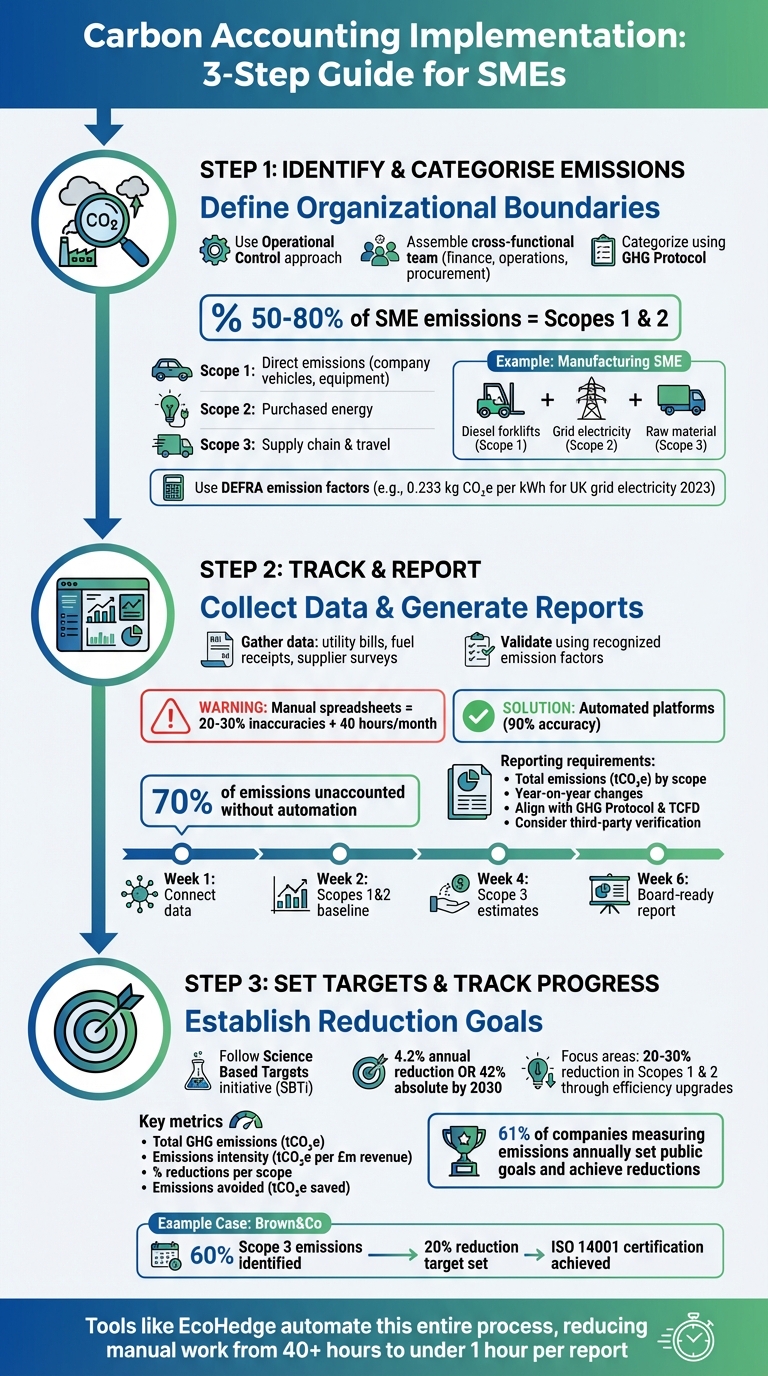
Carbon Accounting Implementation Guide for SMEs: 3-Step Process
You don’t need a huge budget or a dedicated sustainability team to dive into carbon accounting. By breaking the process into clear, manageable steps, small and medium-sized enterprises (SMEs) can map out their emissions and showcase progress to investors.
Identifying and Categorising Your Emissions
The first step is defining your organisational boundaries using the Operational Control approach. This means accounting for 100% of emissions from operations where you have full authority to implement policies. From there, assemble a team that includes finance, operations, and procurement experts to inventory activities using templates from the Greenhouse Gas (GHG) Protocol.
Here’s a quick breakdown of the GHG Protocol’s categories:
- Scope 1: Direct emissions (e.g., company-owned vehicles or equipment).
- Scope 2: Indirect emissions from purchased energy.
- Scope 3: Other indirect emissions, like supply chain and employee travel.
For many SMEs, Scopes 1 and 2 make up 50–80% of total emissions, making them a logical starting point for action. For example, a manufacturing SME might categorise diesel forklifts as Scope 1, grid electricity as Scope 2, and raw material transport as Scope 3.
To calculate emissions, collect data from utility bills, fuel receipts, and supplier surveys. Use DEFRA emission factors for precise calculations - for instance, 0.233 kg CO₂e per kWh for UK grid electricity in 2023. When tackling Scope 3, focus on high-impact areas by prioritising suppliers with the largest spend, as they often contribute the most to supply chain emissions.
Tracking and Reporting Your Emissions
Reliable data is the backbone of carbon accounting. Gather information from sources like utility meters, purchase invoices, and travel logs. Validate this data using recognised emission factors. Keep in mind that manual spreadsheets can lead to 20–30% inaccuracies and require over 40 hours of work each month.
Automated platforms like EcoHedge can save both time and effort. These tools integrate directly with energy providers and suppliers via APIs, pulling real-time data and applying GHG Protocol calculations automatically. EcoHedge also flags anomalies and uses AI-driven spend-based estimates to address gaps in supplier data - an issue that can leave up to 70% of emissions unaccounted for. This automation boosts efficiency, achieving around 90% accuracy.
When it’s time to report, align with frameworks like the GHG Protocol and TCFD by disclosing total emissions (tCO₂e) by scope and year-on-year changes. For added credibility, consider third-party verification and follow GRI standards for transparency. Tools like EcoHedge can generate polished PDF reports featuring benchmarks and visualisations, such as a 20% reduction in Scope 2 emissions through energy-saving measures like LED lighting. These reports also help SMEs comply with UK Streamlined Energy and Carbon Reporting (SECR) requirements.
Once your data is in place, the next step is to set measurable reduction targets.
Setting Reduction Targets and Tracking Progress
With your emissions baseline established, it’s time to set reduction goals. Following the Science Based Targets initiative (SBTi), you can aim for realistic cuts, like a 4.2% annual reduction or an absolute 42% reduction by 2030. Start with high-impact areas - reduce Scopes 1 and 2 by 20–30% through efficiency upgrades, and tackle Scope 3 by working closely with suppliers.
For instance, a UK logistics SME might set a target to transition 50% of its fleet to electric vehicles by 2028, using EcoHedge to model different scenarios. Track your progress with key metrics such as:
- Total GHG emissions (tCO₂e)
- Emissions intensity (tCO₂e per £m revenue)
- Percentage reductions per scope
- Emissions avoided (tCO₂e saved)
Establish KPIs like keeping data gaps under 5%, and use monthly dashboard updates to stay on track.
Take the example of Brown&Co, a UK SME. They used automated tools to categorise 60% of their emissions as Scope 3, set a 20% reduction target, and formed an environmental subcommittee to drive efficiency improvements. This effort not only helped them achieve ISO 14001 certification but also strengthened investor confidence through verifiable data. Their progress, monitored via automated dashboards, highlights how consistent tracking builds trust. In fact, research shows that 61% of companies that measure emissions annually set public goals and achieve reductions, demonstrating how regular tracking supports net-zero ambitions.
Using EcoHedge to Create Investor-Ready Reports
Once you've established your baseline and set your targets, the next step is presenting your data in a way that earns investor trust. Relying on manual reporting can lead to errors and wasted time, which is why automated solutions like EcoHedge tackle these challenges head-on.
EcoHedge Features and Benefits
EcoHedge integrates seamlessly with popular accounting tools such as Xero, QuickBooks, Sage, and Zoho, pulling in financial and operational data automatically. This eliminates the need for cumbersome surveys and manual spreadsheets. The platform adheres to GHG Protocol standards, tracking all emission scopes, which is especially crucial since up to 90% of an SME's carbon footprint often comes from Scope 3 emissions - areas beyond direct control. This comprehensive tracking is vital for building investor trust.
Another standout feature is scenario analysis, which allows businesses to forecast the effects of operational changes, such as adopting electric vehicles or switching to renewable energy sources.
Elle, a business owner, shared her experience with EcoHedge:
"EcoHedge has been an invaluable asset to my business as we tackle the demands of selling our products to larger corporations. The need for sustainability reports had become a significant roadblock to securing deals."
Creating Reports That Investors Want to See
EcoHedge goes beyond data collection by converting raw numbers into polished, investor-ready reports. Investors expect detailed, verifiable information that outlines both your current emissions baseline and progress towards reduction targets. To meet these expectations, EcoHedge generates a "Carbon Flash Report" tailored for stakeholders, including investors, customers, and even employees.
These reports feature year-on-year comparisons, detailed methodology notes, and audit-ready outputs that comply with industry standards. Impressively, EcoHedge can turn raw data into a verified carbon report in less than an hour. Reports include critical metrics such as total emissions (tCO₂e), percentage reductions, and emissions intensity (tCO₂e per £m revenue) - key data points investors scrutinise when assessing sustainability efforts and risk levels.
For SMEs, the typical implementation timeline is as follows: connect your data in Week 1, establish Scope 1 and 2 baselines by Week 2, estimate Scope 3 emissions by Week 4, and deliver a board-ready report by Week 6. This quick turnaround is especially beneficial when responding to tender requests or investor due diligence. These detailed, transparent reports not only meet investor expectations but also strengthen your competitive edge in the market.
Affordable Pricing for SMEs
EcoHedge offers pricing plans designed to suit SME budgets, ensuring businesses of all sizes can access investor-ready reporting. The Starter Plan begins at £24 per month (or £240 per year, excluding VAT), providing pay-as-you-go reports (£199 per report), CSV upload options, and email support. For businesses requiring more robust features, the Growth Plan costs £99 per month (or £990 per year, excluding VAT) and includes unlimited reports, Xero integration, advanced analytics, and priority support.
For those looking for a no-cost option, the Lite plan is free and offers basic Scope 3 tracking and GHG Protocol alignment, though it lacks historical comparisons and full compliance reports. Meanwhile, the Express plan - priced at £999 per year - provides full automation across all three scopes, year-on-year comparisons, and compliance-ready reporting.
| Plan | Price | Key Features |
|---|---|---|
| Lite | Free | Basic Scope 3 tracking, GHG Protocol aligned |
| Starter | £24/month (£240/year) | Pay-as-you-go reports (£199/report), CSV upload, email support |
| Growth | £99/month (£990/year) | Unlimited reports, Xero integration, advanced analytics, priority support |
| Express | £999/year | Full automation, Scopes 1–3 tracking, year-on-year comparisons |
With businesses that fail to report emissions potentially losing up to 50% of their earnings, and sustainability-focused companies gaining access to an estimated £5 trillion in procurement opportunities, investing in automated carbon accounting is a smart move.
What Investors Look for in Carbon Reports
Key Metrics Investors Expect
Investors want carbon reports that follow established frameworks like the Greenhouse Gas (GHG) Protocol or ISO 14064. These standards ensure reports are consistent and allow for fair comparisons across companies. Aimée Tennant, Co-founder of Seedling, emphasises this point:
"Consistency of carbon accounting methodologies between businesses is important because it enables investors, consumers, and other stakeholders to compare the sustainability credentials of businesses on a like-for-like basis."
A detailed breakdown of emissions, categorised by Scope 1, 2, and 3 and expressed in CO₂e, is non-negotiable. Scope 3 emissions, given their significant impact, should always be included.
Investors favour activity-based data - like kilometres travelled or litres of fuel used - over spend-based metrics because it paints a more accurate picture of emissions. Additionally, a decarbonisation roadmap is a must. This should pinpoint emissions hotspots and lay out actionable reduction strategies. Since January 2022, the Financial Conduct Authority's TCFD regulations have pushed asset managers to request more detailed emissions data from SMEs to account for their "financed emissions".
Ultimately, providing clear and transparent data not only meets these expectations but also opens doors to better funding opportunities.
How Good Reporting Helps Secure Funding
Comprehensive and transparent carbon reporting builds trust with investors and helps businesses gain access to green finance. It’s not just about compliance - good reporting directly supports funding efforts.
Detailed reports can unlock sustainable finance options like sustainability-linked loans or ESG-focused investment funds, which often come with better terms. Transparency is key. Companies that clearly outline their methodology, organisational boundaries, and any data gaps give investors confidence in their long-term strategy while reducing concerns about greenwashing.
Seedling highlights this growing trend:
"Investors are increasingly concerned about the environmental impact of the companies they fund, making emissions management a key investment criteria and focus of due diligence."
SMEs that provide verified reports and concrete reduction plans often stand out during investor evaluations. Using high-quality carbon offsets, such as those certified by the Gold Standard or the United Nations Clean Development Mechanism, further strengthens credibility. Beyond investor confidence, robust carbon reporting enhances competitiveness. With 72% of consumers factoring in sustainability when purchasing and 68% of job candidates favouring environmentally responsible employers, clear and verified reporting benefits the business in multiple ways.
Conclusion
Carbon accounting has become more than just a compliance measure - it's now a strategic investment that boosts investor confidence and fosters growth. SMEs that provide clear, verifiable emissions data aligned with the Greenhouse Gas Protocol stand out in funding evaluations, paving the way for green finance opportunities and ESG-focused investments. With over 6,000 companies globally committing to science-based targets and more than 1,000 striving for net-zero goals, the shift towards climate accountability is gaining unstoppable momentum.
But it’s not just about funding. Carbon accounting also uncovers operational efficiencies that cut costs and improve environmental performance. Take Eltel, a Scandinavian telecom services company, as an example. By leveraging carbon accounting insights, they optimised technician driving routes, saving time, reducing fuel consumption, and cutting emissions all at once. This demonstrates that sustainability initiatives can directly contribute to profitability.
For SMEs with limited resources, tools like EcoHedge make carbon reporting accessible and straightforward. Starting at just £24 per month (excluding VAT), EcoHedge integrates with over 20 accounting applications, automates emissions calculations in line with the GHG Protocol, and generates investor-ready reports - eliminating the hassle of manual spreadsheets. This affordability ensures that even smaller businesses can compete effectively, attract eco-conscious consumers and employees, and meet regulatory demands like the Corporate Sustainability Reporting Directive.
Sustainability is no longer optional. With 72% of consumers considering environmental impact in their purchasing decisions and 68% of job candidates preferring employers with strong environmental credentials, SMEs that adopt carbon accounting position themselves for resilience and success in a market increasingly driven by climate-conscious priorities.
FAQs
What evidence do investors want in an SME carbon report?
Investors prioritise detailed and precise carbon emissions data in SME reports. This means including information on Scope 1, 2, and 3 emissions, as well as clearly outlining strategies and plans for reducing and managing these emissions. Transparent reporting not only signals a commitment to environmental responsibility but also strengthens investor trust.
How can I estimate Scope 3 emissions if suppliers won’t share data?
If suppliers aren't forthcoming with data, you can estimate Scope 3 emissions using proxy data or industry-average emission factors, particularly for categories like "Purchased Goods and Services." To make things easier for suppliers, consider simplified data requests - like asking for estimated quantities or transaction volumes.
Another option is to rely on publicly available data, such as environmental product declarations (EPDs), or use GHG Protocol default factors to estimate emissions. Whatever approach you take, ensure you maintain transparency by clearly documenting your assumptions and methods for reporting purposes.
When should I move from spend-based to activity-based calculations?
When you’re aiming for more precise and practical data on your carbon emissions, switching to activity-based calculations is the way to go. Spend-based calculations rely on financial expenditure to estimate emissions, but they can lack accuracy. On the other hand, activity-based calculations use real-world data - like the amount of fuel consumed or the distance travelled - to give a much clearer view of your emissions. This method is crucial if you want to pinpoint effective ways to cut carbon emissions and hit your sustainability targets with greater precision.