
Big Data for Scope 3 Emissions: Challenges and Solutions

Big Data for Scope 3 Emissions: Challenges and Solutions
Scope 3 emissions, which include indirect emissions across an organisation's entire value chain, often account for 84–90% of a company's total carbon footprint. Tackling these emissions is complex due to inconsistent data, fragmented supply chains, and evolving regulations. Big data can simplify this process by automating data collection, improving accuracy, and identifying emission hotspots.
Key Takeaways:
- Scope 3 emissions categories: Cover upstream (e.g., raw materials, business travel) and downstream (e.g., product use, disposal) activities.
- Challenges: Poor data quality, supplier engagement issues, manual processes, and regulatory pressures.
- Solutions: Automated tools, machine learning for analysis, and supplier collaboration platforms like EcoHedge.
Big data enables organisations to move from rough estimates to precise, supplier-specific insights, helping them meet reporting standards and reduce emissions effectively.
Webinar: The Practical Guide to Scope 3 Emissions (And Why They Matter Most)
Challenges in Using Big Data for Scope 3 Emissions
While big data holds promise for improving emissions tracking, accurately measuring Scope 3 emissions presents a host of challenges. The Greenhouse Gas Protocol's intricate categorisation makes data collection far more complex compared to Scopes 1 and 2. Michael Lengahan, Associate Director at Anthesis, aptly points out:
You can't manage what you can't measure.
Yet, measuring Scope 3 emissions remains a daunting task. Below are some of the key obstacles that organisations face.
Data Inconsistency and Quality Problems
One major hurdle is the reliance on spend-based estimates. Many organisations use these alongside Environmentally Extended Input-Output factors, which track spending shifts rather than actual reductions in emissions. Supplier data often compounds the problem by relying on outdated methods and excluding crucial elements, such as transportation emissions, especially in supply chains beyond Tier 1. The fragmented nature of supplier networks, combined with inconsistent reporting standards, makes it difficult to obtain reliable data. Adding to the complexity, many suppliers lack the necessary tools or digital infrastructure to measure and report carbon footprints accurately. These issues highlight the pressing need for automated systems and collaborative solutions, which will be explored later.
Managing Data Volume and Integration
The scale of data involved in global supply chains is overwhelming. Collecting, verifying, and integrating this data manually can take months - or even years. The process often relies heavily on emails and spreadsheets, which are inefficient for handling large, unstructured datasets. This fragmented approach creates silos, preventing organisations from gaining a comprehensive view of their emissions. Overcoming these integration challenges requires advanced technological tools, which will be discussed in the next section.
Supplier Engagement and Data Access
Engaging suppliers effectively is another persistent challenge. Smaller suppliers often lack the resources or expertise for carbon footprint analysis, necessitating targeted support such as training, workshops, or co-funding initiatives. Transitioning from secondary, spend-based estimates to primary data sourced directly from suppliers requires significant collaboration and investment. Without such efforts, obtaining reliable and specific data remains difficult. Collaborative platforms, which are crucial for addressing these barriers, will be examined further on.
Regulatory and Compliance Requirements
Rapidly evolving disclosure standards add yet another layer of complexity. As Deloitte notes:
Understanding and keeping up with rapidly evolving standards requires expert knowledge, and ambiguities persist.
Large organisations must navigate multiple overlapping frameworks, such as the Corporate Sustainability Reporting Directive (CSRD) and the Task Force on Climate-related Financial Disclosures (TCFD). The lack of a universal methodology for Scope 3 reporting makes it challenging to ensure consistency across suppliers and regions. Additionally, regulatory bodies are increasingly scrutinising emissions claims, exposing organisations to legal and reputational risks if their data lacks robustness. These challenges underline the need for systematic approaches, which will be addressed in the solutions section.
Solutions: Using Big Data for Scope 3 Emissions
Tackling the challenges of Scope 3 emissions requires advanced technology and cooperative frameworks. Below, we explore how organisations can transition from fragmented spreadsheets and unreliable estimates to precise, actionable emissions data.
Automated Data Collection and Standardisation
Managing complex supply chains with manual data collection - like emails and spreadsheets - is outdated and ineffective. Automated systems now integrate directly with enterprise resource planning (ERP) platforms (e.g., SAP), product lifecycle management (PLM) tools (e.g., Centric), and corporate travel systems (e.g., Egencia). By using API integrations, these systems pull data in real time, cutting out manual processes and enabling quick lifecycle assessments.
Frameworks like the Partnership for Carbon Transparency (PACT) establish a standard methodology for product carbon footprints (PCFs), ensuring consistency across suppliers and tiers. AI-driven tools also help by cleaning and standardising messy, unstructured data from multiple sources. Automated surveys with customisable schedules further streamline collecting vendor data, reducing admin workload and making it easier to measure impact. Shifting from secondary, spend-based data to primary supplier data allows companies to identify specific impact sources. This shift enables "action-attributable" reductions, which reflect genuine operational improvements rather than just changes in spending patterns. These automated systems lay the groundwork for machine learning applications.
Machine Learning for Emissions Analysis
Machine learning offers powerful tools to map out intricate supply chains and identify emission hotspots, such as carbon-heavy products, inefficient logistics, or wasteful processes. These algorithms validate supplier data by detecting anomalies and use predictive modelling to assess how design or procurement changes could affect future carbon footprints. This approach helps businesses focus their reduction efforts on areas with the greatest impact and create data-driven roadmaps for accurately measuring Scope 3 emissions.
Take the example of Mewa, a German textile-sharing company. In 2024, Mewa launched its "City-Hubs" project in Berlin and Hamburg, using data to overhaul its logistics. The company optimised delivery routes and staffing strategies, introduced electric vans and cargo bikes for last-mile deliveries, and even addressed a driver shortage (cargo bike drivers don’t need a standard driving licence). Benjamin Federmann, Mewa's Head of Fleet Strategy & Mobility, remarked:
"Everyone talks about being data-driven, but I don't see many truly data-driven companies when it comes to mobility management... there's no real proactive data management."
While algorithms provide insights, real-time supplier data remains critical for completing the emissions picture.
Supplier Collaboration and Data Sharing Platforms
Engaging suppliers effectively requires digital platforms that simplify data sharing and improve reporting accuracy. These platforms consolidate supplier data into actionable reports, reducing admin work and minimising spreadsheet errors. Organisations can also offer pre-approved greenhouse gas (GHG) accounting providers and tailored training to maintain data consistency. Neutral data trusts, such as the SINE Foundation and Catena-X, combined with homomorphic encryption technologies like secure multi-party computing, allow firms to share emissions data without compromising sensitive information like trade secrets or production costs. Additionally, materiality assessments help companies focus on the most impactful categories of Scope 3 emissions, improving efficiency and supplier engagement.
EcoHedge: Automated Carbon Accounting for Scope 3 Emissions
EcoHedge is an example of how technology and collaboration can come together to simplify carbon accounting. This platform integrates with over 20 accounting applications to calculate and report Scope 3 emissions, addressing challenges like manual workflows and supplier engagement through automation. EcoHedge offers fast, automated categorisation and calculation, enabling organisations to produce carbon reports without manual data entry. Starting at just £24 per month (excluding VAT), the software supports emission tracking aligned with the Greenhouse Gas Protocol scopes. It also aids businesses in planning carbon reductions and performing lifecycle analyses, helping them accurately measure their carbon footprint and involve stakeholders in their sustainability efforts.
sbb-itb-919600f
Comparing Methods for Scope 3 Emissions Measurement
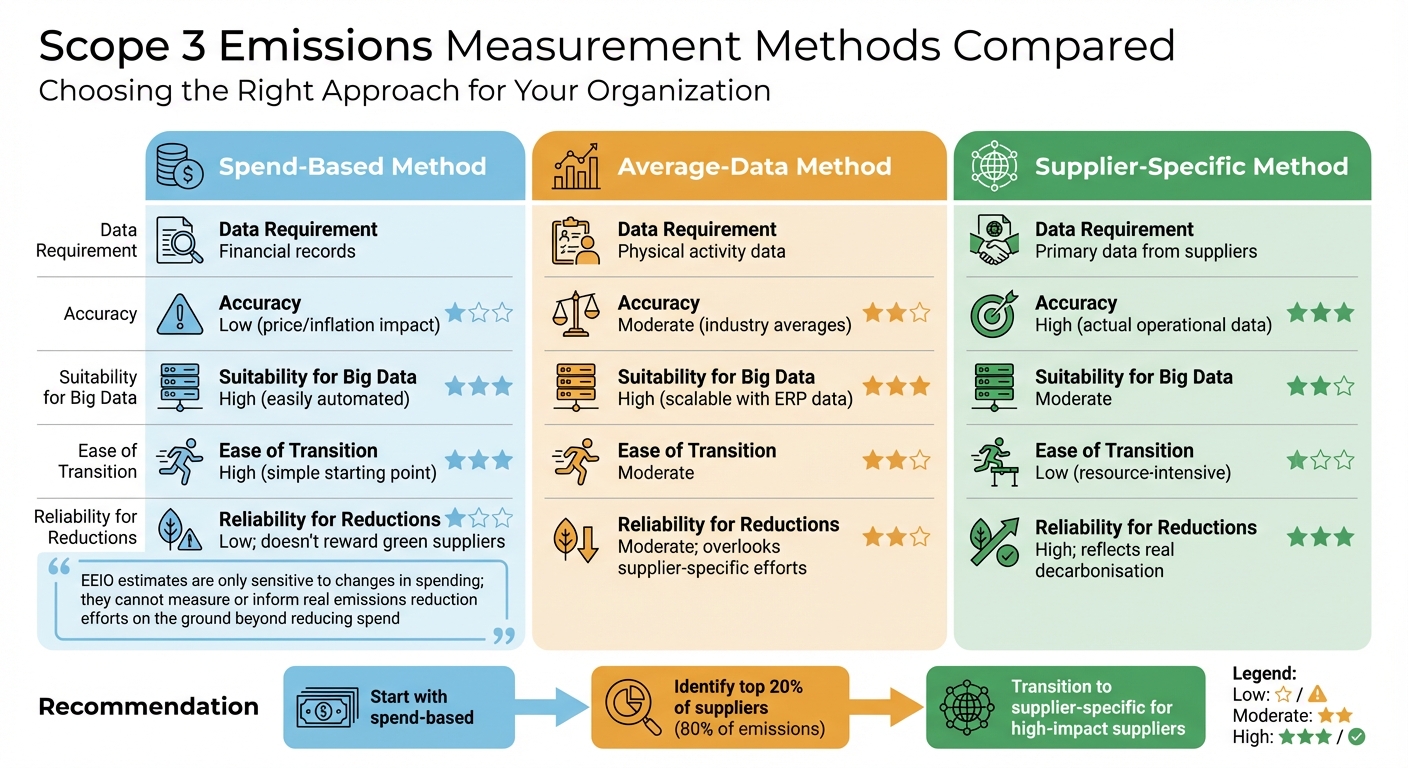
Comparison of Scope 3 Emissions Measurement Methods: Spend-Based vs Average-Data vs Supplier-Specific
After exploring big data solutions, let’s dive into the three main methods for measuring Scope 3 emissions: spend-based, average-data, and supplier-specific. Each method has its strengths and limitations, making the choice dependent on your data availability and organisational priorities.
Spend-based methods rely on financial records from procurement systems. By multiplying spending data by average emission factors, this approach offers a quick baseline assessment. It’s particularly useful for identifying which supplier categories have the largest carbon footprint. However, its accuracy can be skewed by price changes and inflation rather than actual emissions shifts. As Michael Lengahan, Associate Director at Anthesis, explains:
EEIO estimates are only sensitive to changes in spending; they cannot measure or inform real emissions reduction efforts on the ground beyond reducing spend.
For organisations seeking a deeper connection to operational activity, there are more precise alternatives.
Average-data methods take it a step further by incorporating measurable activity data - such as weight, volume, or units purchased - paired with industry averages. This method provides a clearer view of operational emissions but still falls short in distinguishing between suppliers with varying sustainability practices.
Supplier-specific methods offer the most accurate results by collecting primary data directly from suppliers about their operations. This approach not only reflects actual decarbonisation efforts but also highlights which suppliers are leading or lagging in sustainability. The downside? It demands significant resources and supplier engagement. Many organisations begin with spend-based data to pinpoint emission hotspots, then transition to supplier-specific methods for the top contributors - often the 20% of suppliers responsible for 80% of Scope 3 emissions.
Here’s a quick comparison of the three methods:
Comparison Table: Spend-Based, Average-Data, and Supplier-Specific Methods
| Feature | Spend-Based Method | Average-Data Method | Supplier-Specific Method |
|---|---|---|---|
| Data Requirement | Financial records | Physical activity data | Primary data from suppliers |
| Accuracy | Low (price/inflation impact) | Moderate (industry averages) | High (actual operational data) |
| Suitability for Big Data | High (easily automated) | High (scalable with ERP data) | Moderate |
| Ease of Transition | High (simple starting point) | Moderate | Low (resource-intensive) |
| Reliability for Reductions | Low; doesn’t reward green suppliers | Moderate; overlooks supplier-specific efforts | High; reflects real decarbonisation |
Each method serves a purpose, depending on where you are in your emissions measurement journey. While spend-based methods provide a quick foundation, supplier-specific approaches deliver the most actionable insights for driving sustainability.
Conclusion: Managing Scope 3 Emissions with Big Data
Scope 3 emissions typically make up a staggering 84% to 90% of a company's carbon footprint, which makes tackling them a monumental task - especially when relying on outdated tools like spreadsheets. The hurdles are undeniable: inconsistent data, the sheer scale of multi-tier supply chains, hesitant suppliers, and increasingly stringent regulations. However, big data is changing the game by automating data collection, standardising formats, and converting scattered information into practical insights.
The real progress happens when companies move from spend-based estimates to supplier-specific primary data. Accurate measurement is the foundation of effective management. Automated carbon accounting platforms play a crucial role as a single source of truth, enabling businesses to pinpoint emission hotspots, monitor supplier performance, and direct their resources to areas with the most impact.
Take EcoHedge, for example. By automating emissions data integration across more than 20 accounting systems, EcoHedge categorises data under all Greenhouse Gas Protocol scopes. This infrastructure allows companies to achieve detailed, supplier-level transparency, which is key to driving genuine decarbonisation efforts. With 61% of investors now factoring in ESG risks before making decisions, precise Scope 3 reporting has evolved from a regulatory necessity to a competitive edge.
The regulatory environment is also evolving quickly. Consider the U.S. Securities and Exchange Commission's $1.5 million fine imposed on the Bank of New York Mellon in May 2022 for misstating sustainability claims - a clear warning that inaccurate reporting can lead to significant financial and reputational damage. Similarly, mandatory frameworks like the EU's Corporate Sustainability Reporting Directive are making robust data management systems a non-negotiable requirement. These developments highlight the urgent need for focused, impactful strategies.
To make meaningful progress, start by targeting the categories with the highest emissions - often, just 20% of suppliers account for 80% of emissions. Engage these suppliers early, implement automated tools, and use the data to create a virtuous cycle, where supplier improvements directly contribute to your net-zero goals. Big data isn't just a tool for solving the Scope 3 challenge - it transforms emissions management from a compliance burden into a strategic advantage.
FAQs
How does big data enhance the accuracy of Scope 3 emissions reporting?
Big data plays a crucial role in improving the accuracy of Scope 3 emissions reporting. It allows businesses to collect detailed information from across their entire value chain, addressing one of the biggest hurdles - reliability and completeness of emissions data.
With the ability to analyse vast datasets, companies can pinpoint emissions hotspots, prioritise them for action, and engage more effectively with suppliers. This approach doesn't just make reporting more efficient - it also equips businesses with the insights needed to make smarter decisions for cutting emissions and meeting their environmental goals.
What challenges do companies face when collecting emissions data from suppliers?
When it comes to gathering emissions data from suppliers, companies often run into obstacles, especially around data quality, consistency, and collaboration. Many suppliers simply don’t have the capacity to provide reliable, detailed data, which makes calculating Scope 3 emissions a tricky task. On top of that, differences in how suppliers approach data collection and reporting can result in inconsistencies, making analysis and reporting even more complicated.
Another sticking point is the lack of transparency and engagement within supply chains. For organisations working with large or international supplier networks, getting precise emissions data can feel like an uphill battle. This is particularly true when suppliers lack the necessary resources or don’t see the value in participating. Building meaningful relationships with suppliers and focusing on the most impactful areas of the supply chain takes time, effort, and a clear strategy.
That’s where tools like automated carbon accounting software come in. These tools can simplify data collection, improve its accuracy, and encourage better collaboration with suppliers. By using such solutions, businesses can more effectively monitor and reduce their emissions, making progress towards sustainability goals.
How do automated tools like EcoHedge make it easier to track Scope 3 emissions?
Automated tools like EcoHedge make tracking Scope 3 emissions much easier by handling the collection and analysis of complex data automatically. This not only cuts down on manual work but also boosts accuracy and helps ensure compliance with frameworks such as the Greenhouse Gas Protocol.
EcoHedge also makes it simpler to engage with suppliers, helping businesses collect and manage data from their value chain more efficiently. By offering clear insights and practical recommendations, these tools allow organisations to concentrate on cutting emissions and meeting their sustainability targets with greater confidence.