
How to Align Reporting with Procurement Deadlines

How to Align Reporting with Procurement Deadlines
Aligning sustainability reporting with procurement deadlines is no longer optional - it’s a necessity for businesses navigating regulatory demands like the EU’s CSRD. Misaligned timelines often lead to rushed data collection, compliance risks, and missed opportunities to integrate sustainability into procurement decisions. Here's how to fix that:
- Synchronise timelines: Map procurement milestones (like tenders, renewals, and evaluations) to reporting deadlines.
- Automate data collection: Use tools to centralise emissions data from suppliers and integrate it into procurement workflows.
- Embed sustainability in contracts: Make emissions reporting and reduction plans a standard part of supplier agreements.
- Set clear roles: Assign accountability for tasks like Scope 1, 2, and 3 emissions tracking.
- Train teams: Equip procurement and sustainability teams with the knowledge to collaborate effectively.
Manual processes and scattered data make compliance harder. Automating workflows and creating shared calendars can streamline reporting, reduce errors, and align procurement with sustainability goals. Tools like EcoHedge simplify carbon reporting, enabling businesses to meet deadlines without compromising accuracy. When reporting becomes part of procurement, it drives better decisions and long-term progress.
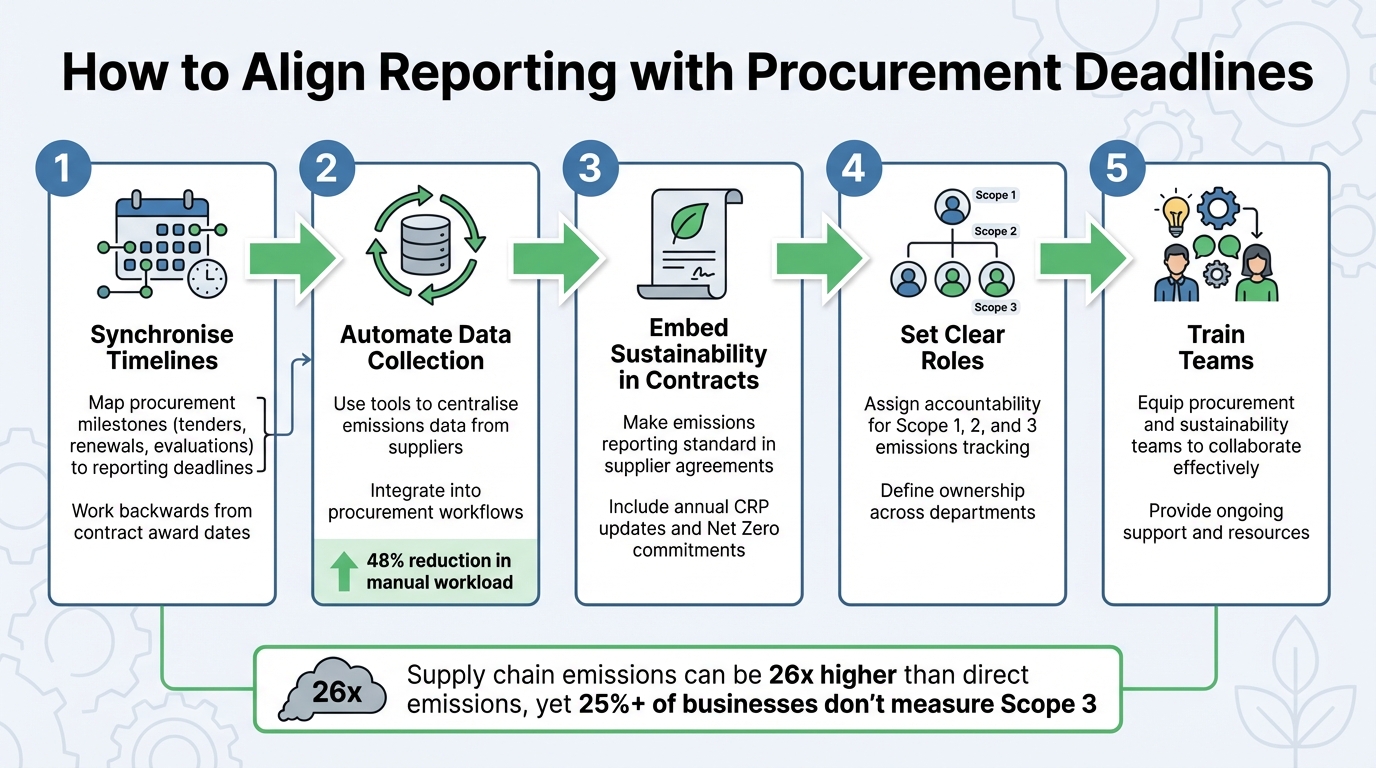
5-Step Process to Align Sustainability Reporting with Procurement Deadlines
Sustainability in Sync: Aligning Short-Term Action with Long-Term Value
Procurement Deadlines and Reporting Requirements
Aligning procurement and sustainability timelines is crucial to avoid last-minute data collection and compliance issues. Many organisations operate on predictable procurement cycles - like regular supplier evaluations, annual contract renewals, and scheduled tenders - while sustainability reporting adheres to separate regulatory deadlines and stakeholder demands. When these timelines don’t match up, businesses often scramble to gather emissions data or risk breaching reporting obligations.
Mapping out these key milestones helps clarify how sustainability requirements fit into procurement processes.
Common Procurement Milestones
Procurement typically follows a structured process with clear stages. During the go-to-market phase, organisations define supplier engagement rules and sustainability benchmarks before inviting bids. For instance, UK government contracts exceeding £5 million annually (VAT included) require suppliers to submit a Carbon Reduction Plan (CRP) as a condition for participation. This requirement applies from the tender’s publication to the contract award.
Next comes supplier onboarding and assessment, where bidders are evaluated on sustainability criteria, often on a pass/fail basis. This includes a commitment to achieving Net Zero by 2050. Before awarding the contract or appointing suppliers to a framework, authorities must verify that successful bidders still meet their Net Zero commitments. This double-check ensures sustainability promises remain valid throughout the process.
The contract renewal and monitoring phase involves ongoing obligations. Suppliers must update their CRPs annually and publish them online to keep contracts active. For live agreements, authorities may implement a Carbon Reduction Contract Schedule, setting specific decarbonisation goals and monitoring progress over the contract’s duration. This highlights that sustainability reporting isn’t a one-off task but a continuous requirement tied directly to procurement activities.
Sustainability Reporting Requirements
The Greenhouse Gas Protocol outlines how emissions should be measured and reported across three scopes.
- Scope 1 includes direct emissions from sources owned or controlled by the organisation, such as boilers, fleet vehicles, and air conditioning leaks.
- Scope 2 captures indirect emissions from purchased energy, like electricity, heating, and cooling.
- Scope 3 covers all other indirect emissions across the value chain, including business travel, waste management, purchased goods, and employee commuting.
For UK public sector procurement, reporting obligations differ by scope. Central government bodies must report all domestic Scope 1 and Scope 2 emissions, while Scope 3 reporting is only mandatory if material to the organisation. Although the Greenhouse Gas Protocol lists 15 categories under Scope 3, government procurement focuses on a narrower set, particularly supply chain and transportation emissions. This approach ensures a balance between comprehensive reporting and practical application.
Data accuracy and timeliness are critical for procurement compliance. Suppliers’ CRP data must cover a period no older than 12 months before the procurement process begins. This ensures emissions figures are up-to-date and relevant to the contract. Businesses trading for less than 12 months must confirm their Net Zero commitment and publish a CRP as soon as possible. For consortium bids, each member must submit their own CRP.
Building a Shared Calendar for Alignment
Bringing procurement milestones and reporting deadlines together in a shared calendar can make a world of difference. Without this centralised view, procurement teams might issue tenders without having the necessary sustainability data, or compliance teams could miss vital deadlines simply because they weren’t aware of upcoming contract renewals. A shared calendar removes these blind spots, giving everyone involved a clear picture of what needs to happen and when. This clarity helps map timelines accurately and ensures tasks are assigned without confusion.
Mapping Timelines and Milestones
Start with the end in mind. If your contract needs to be awarded by 31 March 2026, work backwards to outline each phase. This includes requisition and approval, vendor selection, issuing RFQs or RFPs, bid evaluations, contract negotiations, and implementation. Align these steps with reporting milestones like initial submissions, periodic updates, or statutory deadlines tied to the financial year-end.
Identify your critical path - the sequence of tasks that determines the overall timeline. For instance, a two-week legal review must be completed before awarding the contract. Factor in buffer time for reviews, vendor vetting, or rework to avoid delays. Organisations using modern procurement tools have seen cycle times shrink by up to three times, with 69% less manual work involved.
For public procurement, transparency notices are essential. Publishing a planned procurement notice between 12 months and 40 days before a tender can cut tendering timelines to as little as 10 days.
Assigning Roles and Responsibilities
Every milestone needs a clear owner. Assign specific tasks to the relevant teams - for example, IT can finalise technical specs, Procurement can issue the RFQ, and Compliance can manage initial reporting once the contract is awarded.
"The schedule is one of the most important pieces of the project plan. Without a schedule, your team cannot know what to do, when to do it, or when the end product is due." – Dr Stefan Oborski, Director of Project Management, Red River
Set up regular checkpoint meetings and use standardised reporting formats so everyone knows when decisions need to be made. Allocate responsibilities based on data types; for example, Supply Chain could handle Scope 3 emissions, while Facilities focus on Scopes 1 and 2. Involve your Audit Committee in the materiality assessment process to ensure key judgements and data meet the same standards as financial reports.
Once your timelines are clear, assigning ownership ensures no deadline is missed.
Adding Sustainability Data to Procurement Workflows
Incorporating sustainability data directly into procurement tools like RFPs, contracts, scorecards, and onboarding processes ensures that carbon data is seamlessly integrated into day-to-day operations. This method reduces friction by aligning sustainability metrics with routine transactional details such as purchase orders and invoices.
Currently, 49.5% of procurement professionals identify poor-quality data as a significant challenge. Meanwhile, supply chain emissions can be 26 times higher than direct emissions, and over 25% of businesses fail to measure Scope 3 emissions. Addressing these gaps requires embedding sustainability data into existing systems rather than building entirely separate reporting mechanisms.
Automating Data Collection
Manual data collection is slow, prone to errors, and doesn’t support real-time updates. Automating this process centralises data from supplier portals, utility providers, and logistics systems, while flagging discrepancies in real time. By integrating sustainability metrics into existing Electronic Data Interchange (EDI) systems, businesses can gather item-level carbon footprints alongside routine transactions like purchase orders and invoices.
"By layering ESG data into the same systems that already manage item-level and order-level data, companies can reduce manual follow-up and make sustainability part of routine data exchange." – Optera
Start with a materiality assessment to identify high-impact categories and run a pilot programme with a select group of suppliers. This phased approach allows for testing and refining methodologies without overwhelming teams. Leveraging AI-powered platforms can also streamline data collection, pulling information from various internal sources to generate compliance-ready reports that align with procurement schedules. Once automated systems are in place, integrating sustainability insights into procurement decisions becomes much simpler.
Using Data for Procurement Decisions
Sustainability metrics can be directly incorporated into vendor selection and risk assessments. For example, include questions in RFPs about emissions inventories and reduction targets, and score suppliers on their climate readiness alongside traditional factors like cost and quality. Contracts should mandate annual emissions reporting and participation in decarbonisation initiatives.
Supplier scorecards are another valuable tool for tracking data accuracy and progress toward reduction goals. Use these scorecards to identify and address hotspots, focusing on suppliers with the largest contributions to your Scope 3 emissions. Keeping sustainability at the forefront of supplier relationships - not just during initial selection - ensures continuous improvement. With only 30.3% of businesses currently equipped with tools for baselines, targets, and performance tracking, building this capability now can prepare your organisation for evolving regulatory demands.
sbb-itb-919600f
Training Teams for Cross-Department Collaboration
To align sustainability reporting with procurement deadlines, teams must first understand the importance of sustainability and how to manage relevant data. Without proper training, sustainability efforts risk becoming a box-ticking exercise rather than a collective priority. Building this shared understanding is key to fostering effective communication across departments.
Setting Communication Expectations
For sustainability and procurement teams to work in harmony, clear communication protocols are essential. Defining reporting standards and embedding them into existing workflows - like RFPs, contracts, and scorecards - creates a sense of accountability. Formal governance structures can further support this by holding specific teams responsible for meeting sustainability deadlines. For example, regular collaboration between sustainability teams and data owners to address updates or corrections ensures accountability remains a priority.
Involving non-sustainability teams early on is another critical step. By integrating sustainability data into tools and processes already in use, like supplier management systems, organisations can encourage quicker adoption.
"Sustainability must become part of the tools, systems, and processes that already shape supplier relationships every day." – Optera
Given that supply chains contribute roughly 80% of an organisation's total emissions, procurement and commercial teams play a crucial role in achieving sustainability goals. Instead of relying solely on a centralised sustainability team, embedding expertise within procurement ensures that risks and opportunities are addressed at every stage of the commercial process.
Clear communication protocols, supported by targeted training, ensure that all team members are prepared to contribute meaningfully to sustainability reporting efforts.
Providing Sustainability Training
Practical training can empower teams to use sustainability platforms effectively and manage automated data flows efficiently. A good example is Salesforce, which significantly reduced its carbon accounting process time through cross-functional training, highlighting the value of engaging stakeholders early.
To scale training efforts, organisations can develop resources like "GHG 101" webinars or reporting guides, enabling procurement teams and suppliers to educate themselves on climate expectations. Covering the four main carbon accounting methods - spend-based, average-data, hybrid, and supplier-specific - helps teams balance accuracy with ease of use. Tools like EcoHedge make this process smoother by automating data collection and producing compliance-ready reports, easing the learning curve for those new to carbon accounting.
Ongoing support, such as help desks or user communities, is equally important for maintaining progress. By equipping teams with the right tools and knowledge, organisations can ensure consistent reporting that aligns seamlessly with procurement schedules.
Monitoring Progress and Adjusting Strategies
Once teams are trained and workflows are in place, it's essential to keep an eye on performance. Use clear KPIs and feedback systems to spot any issues and fix them quickly. Pair these efforts with measurable metrics to gauge improvement effectively.
Metrics to Track
To maintain momentum with integrated workflows and cross-team training, focus on tracking specific performance metrics. Key KPIs include on-time report submissions, supplier compliance, and greenhouse gas emissions (covering Scopes 1, 2, and significant Scope 3 emissions, measured in tonnes of CO2e) . In the UK, sustainability reporting is a legal requirement for central government bodies with over 500 full-time employees or more than £500 million in operating income.
Additionally, monitor supplier-specific data, such as actual energy consumption (kWh) compared to expenditure (£), to uncover inefficiencies . The "comply or explain" approach, as outlined in the UK Sustainability Reporting Guidance, requires teams to either meet compliance standards or document why they haven't, alongside plans to address the gaps.
Creating Feedback Loops
Regular feedback is key to keeping everything on track. Hold monthly or quarterly meetings between procurement and reporting teams to assess progress, tackle challenges, and fine-tune processes throughout the procurement cycle .
These sessions are also an opportunity to support suppliers. Offer training, introduce simpler reporting tools, such as carbon tracking software, and, when necessary, conduct audits or verifications. Automated platforms that flag anomalies can turn static data into actionable insights, ensuring continuous improvement .
Using EcoHedge for Automated Carbon Reporting
EcoHedge provides automated carbon reporting tools designed to seamlessly integrate with existing procurement systems, eliminating delays caused by manual processes. As procurement deadlines approach, traditional carbon accounting methods - often reliant on spreadsheets - can slow things down. EcoHedge tackles this by using an automated calculation engine that produces sustainability reports in just minutes instead of weeks. For small and medium-sized enterprises (SMEs) needing to supply emissions data, this quick turnaround is a game-changer. It also sets the stage for adopting more detailed and real-time carbon accounting solutions.
Automated Carbon Accounting
EcoHedge supports reporting for Scope 1, Scope 2, and key Scope 3 emissions, utilising UK DESNZ emission factors in line with the GHG Protocol. The platform offers two calculation methods:
- Spend-based: Converts financial data (£) into CO2 equivalents.
- Activity-based: Tracks energy use (kWh) and vehicle activity with greater accuracy.
AI technology automates tasks like categorising data, matching suppliers, and selecting emission factors, reducing manual workload by 48%.
"The need for sustainability reports had become a significant roadblock to securing deals, but EcoHedge helped by offering a quick and cost-effective solution. Within minutes of signing up, I had access to the data required to meet the demands of our corporate buyers." – Elle, Business Owner
A user-friendly workflow ensures that teams can handle carbon accounting without needing specialist knowledge. Features like pre-set categories and review trails enable collaboration across finance, operations, and advisors, ensuring reports are audit-ready when procurement teams request them.
Real-Time Data Integration
EcoHedge goes beyond streamlined calculations by linking real-time financial data directly to carbon reporting. The platform integrates with over 20 accounting tools, including Xero, QuickBooks, Sage, and Zoho, to automatically sync reconciled data and direct costs. This integration simplifies data extraction and categorisation by mapping financial records to emissions categories in real time.
An interactive dashboard provides live insights into emission hotspots, helping teams adjust strategies before procurement deadlines. Businesses can also download branded PDF reports and display a "Climate commitment badge" to highlight their sustainability efforts. Pricing includes a Growth plan at £99/month (billed annually at £990) with unlimited reporting, and a Starter plan at £24/month (billed annually at £240), which includes CSV uploads and pay-per-report pricing at £199 each.
Conclusion
Synchronising sustainability reporting with procurement deadlines transforms last-minute compliance efforts into a valuable strategic tool. When data flows seamlessly from RFPs to supplier contracts, sourcing decisions can be based on real-time insights, paving the way for more effective and modern procurement practices.
The days of relying on manual spreadsheets are numbered, thanks to activity-based calculations and stricter CSRD regulations. Automated solutions, such as those offered by EcoHedge, integrate directly with financial systems to eliminate administrative burdens. This ensures audit-ready reports align perfectly with procurement cycles, making sustainability data an integral part of decision-making.
"Organizations that proactively invest in supplier collaboration, AI-powered emissions tracking and structured reporting will turn compliance into a competitive advantage." – GEP
By embedding sustainability metrics into procurement scorecards alongside cost and quality, businesses send a clear message to suppliers: environmental performance is non-negotiable. This approach not only satisfies regulatory demands but also highlights emission hotspots where targeted reductions can have the greatest impact. Automated platforms free up teams to focus on broader sustainability strategies, while real-time dashboards allow for proactive adjustments.
When departments collaborate effectively, timelines are clear, and automation drives processes, organisations lay the groundwork for achieving long-term sustainability goals. Aligning reporting with procurement workflows makes compliance an ongoing effort, strengthens supplier partnerships, and ensures businesses stay ahead of ever-changing regulations.
FAQs
How does automating data collection support procurement compliance?
Automating data collection improves procurement compliance by boosting data accuracy and ensuring all information remains traceable and current. With fewer manual errors, organisations can more easily meet regulatory requirements and maintain a higher level of transparency.
On top of that, automation makes supplier engagement more efficient by simplifying processes and ensuring consistent communication. This not only saves time but also helps organisations align their sustainability reporting with procurement deadlines more seamlessly.
What procurement milestones are crucial for aligning with sustainability reporting?
To bring sustainability reporting in line with procurement practices, certain milestones are crucial. One key step is weaving carbon reduction commitments directly into procurement processes. This includes embedding greenhouse gas reduction targets and net-zero objectives into contracts from the very beginning.
Another vital milestone is preparing and submitting Carbon Reduction Plans (CRPs). These plans not only show compliance with environmental standards but also lay out clear strategies for cutting emissions. To stay on track, CRPs need to be completed, reviewed, and approved within procurement timelines, ensuring they align with legal requirements like the Climate Change Act 2008.
By integrating these steps into procurement workflows, organisations can create a transparent approach to reporting while staying on course to meet their sustainability goals.
What are the benefits of integrating sustainability data into procurement processes?
Integrating sustainability data into procurement processes equips businesses with the tools to make smarter, more responsible decisions. By monitoring emissions - particularly Scope 3 emissions from suppliers and logistics - companies can pinpoint carbon-intensive areas, evaluate supplier performance, and select partners who share their sustainability priorities. This not only lowers the supply chain's carbon footprint but also aligns with broader environmental goals.
Incorporating sustainability into procurement workflows also fosters stronger supplier relationships and promotes collaborative efforts to reduce emissions. Sharing accurate emissions data can lead to improved efficiency, cost savings, and even open doors to new market opportunities. Beyond these benefits, aligning procurement with sustainability helps businesses comply with regulations, enhances their brand image, and underscores a commitment to ethical and responsible practices.